


Page 74 - Tagalog for Beginners: An Introduction to Filipino, the National Language of the Philippines
P. 74
that “Coffee likes Clara.”


            II. The words “gusto” and “ayaw” and pronouns
                 The words gusto and ayaw are used with the possessive pronouns ko, mo, niya,
                 namin, natin, ninyo, and nila.
                     Thus we say, “Gusto ko ng kape.”

                     Do not use the pronouns ako, ikaw or ka, siya, kami, tayo, kayo, and sila.
                 The sentence “Gusto ako ng kape.” means that “Coffee likes me.”


            III. The marker “ng” instead of the marker “ang”
                 The use of ng instead of “ang” in the “coffee” dialogue can best be explained by
                 equating it with English sentences:

                     “Gusto mo ba ng kape?” Would you like (some) coffee?” In this sentence, by
                 using the marker ng, “coffee” is marked as the object of the sentence.
                     If we replace ng with the marker ang, then the meaning changes: “Gusto mo
                 ba ang kape?” means “Do you like the coffee?”


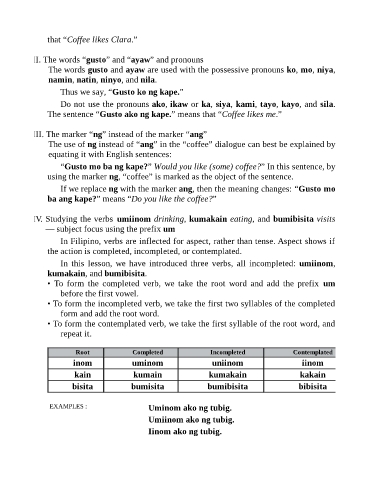
            IV. Studying the verbs  umiinom drinking, kumakain eating, and bumibisita visits

                — subject focus using the prefix um
                     In Filipino, verbs are inflected for aspect, rather than tense. Aspect shows if
                 the action is completed, incompleted, or contemplated.

                     In this lesson, we have introduced three verbs, all incompleted: umiinom,
                 kumakain, and bumibisita.
                 •  To  form  the  completed  verb,  we  take  the  root  word  and  add  the  prefix  um
                     before the first vowel.
                 • To form the incompleted verb, we take the first two syllables of the completed
                     form and add the root word.
                 • To form the contemplated verb, we take the first syllable of the root word, and
                     repeat it.


                          Root               Completed                 Incompleted                Contemplated
                         inom                uminom                    uniinom                       iinom

                          kain               kumain                   kumakain                      kakain
                         bisita             bumisita                  bumibisita                    bibisita


                 EXAMPLES :                       Uminom ako ng tubig.

                                                  Umiinom ako ng tubig.
                                                  Iinom ako ng tubig.

