


Page 75 - Tagalog for Beginners: An Introduction to Filipino, the National Language of the Philippines
P. 75
In these sentences, we know that the focus is on the subject “ako” because the
             object “tubig” is marked by ng.
                  These sentences respond to “who” questions:
                        Sino ang uminom ng tubig? Who drank the water?

                        Ako ang uminom ng tubig. (literally, I marker drank marker water.) OR
                        Uminom ako ng tubig. (literally, Drank I marker water.)


            V. Studying the verbs “ umiinom drinking,” “kumakain eating,”  and  “bumibisita
                visits”—object focus using the affix in

                     The  most  difficult  part  of  grammar,  however,  is  that  the  suffix  changes
                 depending on the focus. When the focus in on the object, we use the affix in.
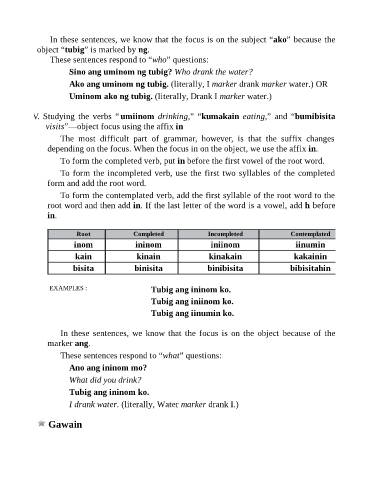
                     To form the completed verb, put in before the first vowel of the root word.

                     To form the incompleted verb, use the first two syllables of the completed
                 form and add the root word.

                     To form the contemplated verb, add the first syllable of the root word to the
                 root word and then add in. If the last letter of the word is a vowel, add h before
                 in.


                          Root               Completed                Incompleted                Contemplated
                         inom                 ininom                   iniinom                     iinumin
                          kain                kinain                  kinakain                    kakainin

                         bisita               binisita                binibisita                 bibisitahin


                 EXAMPLES :                        Tubig ang ininom ko.

                                                   Tubig ang iniinom ko.
                                                   Tubig ang iinumin ko.


                     In these sentences, we know that the focus is on the object because of the
                 marker ang.

                     These sentences respond to “what” questions:
                        Ano ang ininom mo?

                        What did you drink?
                        Tubig ang ininom ko.

                        I drank water. (literally, Water marker drank I.)


                 Gawain

