


Page 57 - Motor Trend (April 2020)
P. 57
COMPARISON


                                                                                                          So we devised a plan: We’d drive both
                                                                                                       cars north to the growing vineyard town
                                                                                                       of Paso Robles, with Reynolds driving the
                                                                                                       gas Kona and me the electric one on the
                                                                                                       northbound leg, swapping cars for the
                                                                                                       return south.
                                                                                                          Normally a 220-mile trip that would
                                                                                                       take between four and five and a half
                                                                                                       hours, depending on traffic, the drive is
                                                                                                       about the same distance as a trip from
                                                                                                       New York to Washington, D.C. or Chicago
                                                                                                       to Detroit. In other words, it’s a realistic

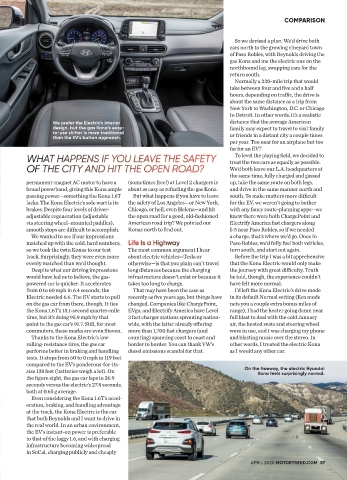
                         We prefer the Electric’s interior                                             distance that the average American
                         design, but the gas Kona’s easy-                                              family may expect to travel to visit family
                         to-use shifter is more traditional                                            or friends in a distant city a couple times
                         than the EV’s button approach.
                                                                                                       per year. Too near for an airplane but too
                                                                                                       far for an EV?
                                                                                                          To level the playing field, we decided to
                                                                                                       treat the two cars as equally as possible.
                                                                                                       We’d both leave our L.A. headquarters at
                                                                                                       the same time, fully charged and gassed
             permanent-magnet AC motor to have a          (sometimes free!) at Level 2 chargers is     up, take the same route on both legs,
             broad powerband, giving this Kona ample  about as easy as refueling the gas Kona.         and drive in the same manner north and
             passing power—something the Kona 1.6T          But what happens if you have to leave      south. To make matters more difficult
             lacks. The Kona Electric’s sole wart is its   the safety of Los Angeles—or New York,      for the EV, we weren’t going to bother
             brakes. Despite four levels of driver-       Chicago, or hell, even Helena—and hit        with any fancy route-planning apps—we
             adjustable regeneration (adjustable          the open road for a good, old-fashioned      knew there were both ChargePoint and
             via steering wheel–mounted paddles),         American road trip? We pointed our           Electrify America fast chargers along
             smooth stops are difficult to accomplish.     Konas north to find out.                      I-5 near Paso Robles, so if we needed
               We wanted to see if our impressions                                                     a charge, that’s where we’d go. Once in
             matched up with the cold, hard numbers,                                                   Paso Robles, we’d fully fuel both vehicles,
             so we took the twin Konas to our test        The most common argument I hear              turn south, and start out again.
             track. Surprisingly, they were even more     about electric vehicles—Tesla or                Before the trip I was a bit apprehensive
             evenly matched than we’d thought.            otherwise—is that you plain can’t travel     that the Kona Electric would only make
               Despite what our driving impressions       long distances because the charging          the journey with great difficulty. Truth
             would have led us to believe, the gas-       infrastructure doesn’t exist or because it   be told, though, the experience couldn’t
             powered car is quicker. It accelerates       takes too long to charge.                    have felt more normal.
             from 0 to 60 mph in 6.4 seconds; the           That may have been the case as                I’d left the Kona Electric’s drive mode
             Electric needed 6.6. The EV starts to pull   recently as five years ago, but things have   in its default Normal setting (Eco mode
             on the gas car from there, though. It ties   changed. Companies like ChargePoint,         nets you a couple extra bonus miles of
             the Kona 1.6T’s 15.1-second quarter-mile     EVgo, and Electrify America have Level       range), I had the heater going damn near
             time, but it’s doing 95.9 mph by that        3 fast charger stations sprouting nation-    full blast to deal with the cold January
             point to the gas car’s 91.7. Still, for most   wide, with the latter already offering     air, the heated seats and steering wheel
             commuters, these marks are even Steven.      more than 1,700 fast chargers (and           were in use, and I was charging my phone
               Thanks to the Kona Electric’s low-         counting) spanning coast to coast and        and blasting music over the stereo. In
             rolling-resistance tires, the gas car        border to border. You can thank VW’s         other words, I treated the electric Kona
             performs better in braking and handling      diesel emissions scandal for that.           as I would any other car.
             tests. It stops from 60 to 0 mph in 119 feet
             compared to the EV’s ponderous-for-its-
                                                                                                              On the freeway, the electric Hyundai
             size 138 feet (batteries weigh a lot). On
                                                                                                                    Kona feels surprisingly normal.
             the figure eight, the gas car laps in 26.9
             seconds versus the electric’s 27.8 seconds,
             both at 0.65 g average.
               Even considering the Kona 1.6T’s accel-
             eration, braking, and handling advantage
             at the track, the Kona Electric is the car
             that both Reynolds and I want to drive in
             the real world. In an urban environment,
             the EV’s instant-on power is preferable
             to that of the laggy 1.6, and with charging
             infrastructure becoming widespread
             in SoCal, charging publicly and cheaply

                                                                                                                 APRIL 2020 MOTORTREND.COM  57

