


Page 56 - Motor Trend (April 2020)
P. 56
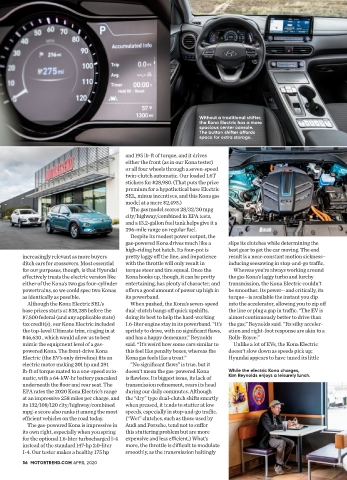
Without a traditional shifter,
                                                                                          the Kona Electric has a more
                                                                                          spacious center console.
                                                                                          The button shifter affords
                                                                                          space for extra storage.


                                                         and 195 lb-ft of torque, and it drives
                                                         either the front (as in our Kona tester)
                                                         or all four wheels through a seven-speed
                                                         twin-clutch automatic. Our loaded 1.6T
                                                         stickers for $28,980. (That puts the price
                                                         premium for a hypothetical base Electric
                                                         SEL, minus incentives, and this Kona gas
                                                         model at a mere $2,495.)
                                                           The gas model scores 28/32/30 mpg
                                                         city/highway/combined in EPA tests,
                                                         and a 13.2-gallon fuel tank helps give it a
                                                         396-mile range on regular fuel.
                                                           Despite its modest power output, the
                                                         gas-powered Kona drives much like a           slips its clutches while determining the
                                                         high-riding hot hatch. Its four-pot is        best gear to get the car moving. The end
           increasingly relevant as more buyers          pretty laggy off the line, and impatience     result is a near-constant motion sickness–
           ditch cars for crossovers. Most essential     with the throttle will only result in         inducing seesawing in stop-and-go traffic.
           for our purposes, though, is that Hyundai     torque steer and tire squeal. Once the          Whereas you’re always working around
           effectively treats the electric version like   Kona hooks up, though, it can be pretty      the gas Kona’s laggy turbo and lurchy
           either of the Kona’s two gas four-cylinder    entertaining, has plenty of character, and    transmission, the Kona Electric couldn’t
           powertrains, so we could spec two Konas       offers a good amount of power up high in      be smoother. Its power—and critically, its
           as identically as possible.                   its powerband.                                torque—is available the instant you dip
             Although the Kona Electric SEL’s              When pushed, the Kona’s seven-speed         into the accelerator, allowing you to zip off
           base prices starts at $38,285 before the      dual-clutch bangs off quick upshifts,         the line or plug a gap in traffic. “The EV is
           $7,500 federal (and any applicable state)     doing its best to help the hard-working       almost continuously better to drive than
           tax credit(s), our Kona Electric included     1.6-liter engine stay in its powerband. “It’s   the gas,” Reynolds said. “Its silky acceler-
           the top-level Ultimate trim, ringing in at    spritely to drive, with no significant flaws,   ation and right-foot response are akin to a
           $46,630 , which would allow us to best        and has a happy demeanor,” Reynolds           Rolls-Royce.”
           mimic the equipment level of a gas-           said. “It’s weird how some cars similar to      Unlike a lot of EVs, the Kona Electric
           powered Kona. The front-drive Kona            this feel like penalty boxes, whereas the     doesn’t slow down as speeds pick up;
           Electric (the EV’s only driveline) fits an     Kona gas feels like a treat.”                 Hyundai appears to have tuned its little
           electric motor making 201 hp and 291            “No significant flaws” is true, but it
           lb-ft of torque mated to a one-speed auto-    doesn’t mean the gas-powered Kona             While the electric Kona charges,
                                                                                                       Kim Reynolds enjoys a leisurely lunch.
           matic, with a 64-kW-hr battery pancaked       is flawless. Its biggest issue, its lack of
           underneath the floor and rear seat. The        transmission refinement, rears its head
           EPA rates the 2020 Kona Electric’s range      during our daily commutes. Although
           at an impressive 258 miles per charge, and  the “dry” type dual-clutch shifts smartly
           its 132/108/120 city/highway/combined         when pressed, it tends to stutter at low
           mpg-e score also ranks it among the most      speeds, especially in stop-and-go traffic.
           efficient vehicles on the road today.          (“Wet” clutches, such as those used by
             The gas-powered Kona is impressive in       Audi and Porsche, tend not to suffer
           its own right, especially when you spring     this stuttering problem but are more
           for the optional 1.6-liter turbocharged I-4   expensive and less efficient.) What’s
           instead of the standard 147-hp 2.0-liter      more, the throttle is difficult to modulate
           I-4. Our tester makes a healthy 175 hp        smoothly, as the transmission haltingly

           56  MOTORTREND.COM APRIL 2020

