


Page 20 - All About History - Issue 53-17
P. 20
REFORMATION


         Day in the life


        A MÜNSTER ANABAPTIST


        DISCOVER THE PRACTICES AND PERILS OF

        LIFE DURING THE MÜNSTER REBELLION

        GERMANY, 1534-35


              In the aftermath of Martin Luther’s Reformation, the German city of
              Münster had become the centre of radical Anabaptism, a Christian
              movement that is an offshoot of Protestantism. Anabaptists had
              flocked to the city after its bishop had granted them religious
              freedom from persecution, but when he changed his mind they
              were able to fight back and take control. They managed to hold
              the city for around 16 months before succumbing to the
              bishop’s brutal siege. The Anabaptist leaders were tortured
              and executed in the marketplace, and their bodies placed
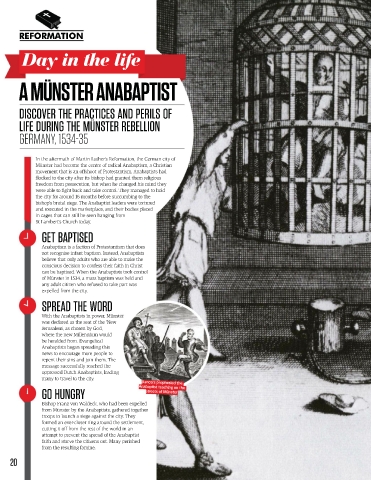
              in cages that can still be seen hanging from
              St Lambert’s Church today.
                GET BAPTISED


                Anabaptism is a faction of Protestantism that does
                not recognise infant baptism. Instead, Anabaptists
                believe that only adults who are able to make the
                conscious decision to confess their faith in Christ
                can be baptised. When the Anabaptists took control
                of Münster in 1534, a mass baptism was held and
                any adult citizen who refused to take part was
                expelled from the city.

                SPREAD THE WORD

                With the Anabaptists in power, Münster
                was declared as the seat of the ‘New
                Jerusalem’, as chosen by God,
                where the new Millennium would
                be heralded from. Evangelical
                Anabaptists began spreading this
                news to encourage more people to
                repent their sins and join them. The
                message successfully reached the
                oppressed Dutch Anabaptists, leading
                many to travel to the city.
                                                   Dancers prophesied the
                                                  Anabaptist teaching on the
                GO HUNGRY                           streets of Münster
                Bishop Franz von Waldeck, who had been expelled
                from Münster by the Anabaptists, gathered together
                troops to launch a siege against the city. They
                formed an ever-closer ring around the settlement,
                cutting it off from the rest of the world in an
                attempt to prevent the spread of the Anabaptist
                faith and starve the citizens out. Many perished
                from the resulting famine.
     20

