


Page 16 - All About History - Issue 53-17
P. 16
REFORMATION


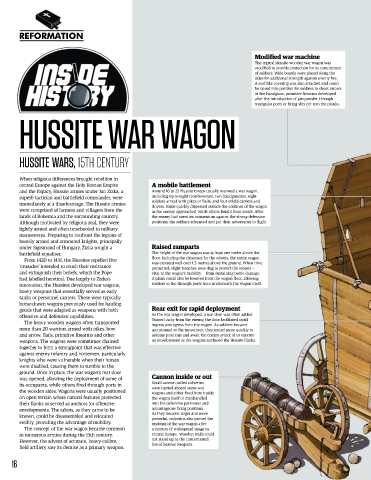
                                                                                           Modified war machine
                                                                                           The typical Hussite wooden war wagon was
                                                                                           modified to provide protection for its complement
                                                                                           of soldiers. Wide boards were placed along the
                                                                                           sides for additional strength against enemy fire.
                                                                                           A roof-like covering was also attached and could
                                                                                           be raised into position for soldiers to shoot arrows
                                                                                           or fire handguns, primitive firearms developed
                                                                                           after the introduction of gunpowder, through
                                                                                           triangular ports or firing slits cut into the planks.

        HUSSITE WAR WAGON


        HUSSITE WARS, 15TH CENTURY


        When religious differences brought rebellion in
        central Europe against the Holy Roman Empire   A mobile battlement
        and the Papacy, Hussite armies under Jan Zizka, a   Around 16 to 22 Hussite troops usually manned a war wagon,
        superb tactician and battlefield commander, were   including up to eight crossbowmen, two handgunners, eight
                                                      soldiers armed with pikes or flails, and four shield carriers and
        immediately at a disadvantage. The Hussite armies
                                                      drivers. Some quickly dispersed outside the confines of the wagon
        were comprised of farmers and villagers from the   as the enemy approached, while others fought from inside. After
        lands of Bohemia and the surrounding country.   the enemy had spent its momentum against the strong defensive
        Although motivated by religious zeal, they were   positions, the soldiers advanced and put their adversaries to flight.
        lightly armed and often unschooled in military
        manoeuvres. Preparing to confront the legions of
        heavily armed and armoured knights, principally
        under Sigismund of Hungary, Zizka sought a    Raised ramparts
        battlefield equaliser.                        The height of the war wagon was at least one metre above the
          From 1420 to 1431, the Hussites repelled five   floor. Including the clearance for the wheels, the entire wagon
                                                      was elevated well over 1.5 metres above the ground. When time
        ‘crusades’ intended to crush their resistance   permitted, slight trenches were dug to protect the wheels —
        and extinguish their beliefs, which the Pope   vital to the wagon’s mobility — from sustaining battle damage.
        had labelled heretical. Due largely to Zizka’s   A plank could also be lowered from the wagon floor, allowing
        innovation, the Hussites developed war wagons,   soldiers to fire through ports from underneath the wagon itself.
        heavy weapons that essentially served as early
        tanks or personnel carriers. These were typically
        horse-drawn wagons previously used for hauling
        goods that were adapted as weapons with both   Rear exit for rapid deployment
        offensive and defensive capabilities.         As the war wagon developed, a rear door was often added.
                                                      Turned away from the enemy, the door facilitated rapid
          The heavy wooden wagons often transported
                                                      ingress and egress from the wagon. As soldiers became
        more than 20 warriors armed with pikes, bow   accustomed to the movement, they exited more quickly to
        and arrow, flails, primitive firearms and other   assume positions and await the enemy attack or to execute
        weapons. The wagons were sometimes chained    an envelopment as the wagons anchored the Hussite flanks.
        together to form a strongpoint that was effective
        against enemy infantry and horsemen, particularly
        knights who were vulnerable when their horses
        were disabled, causing them to tumble to the
        ground. Once in place, the war wagon’s rear door
        was opened, allowing the deployment of some of   Cannon inside or out
                                                      Small cannon called culverins
        its occupants, while others fired through ports in
                                                      were carried aboard some war
        the wooden sides. Wagons were usually positioned   wagons and either fired from inside
        on open terrain where natural features protected   the wagon itself or manhandled
        their flanks or served as anchors for offensive   into the defensive perimeter and
        envelopments. The tabors, as they came to be   advantageous firing positions.
                                                      As they became larger and more
        known, could be disassembled and relocated
                                                      powerful, culverins also proved the
        swiftly, providing the advantage of mobility.  undoing of the war wagon after
          The concept of the war wagon became common   a century of widespread usage in
        in numerous armies during the 15th century.   central Europe. Wooden walls could
                                                      not stand up to the concentrated
        However, the advent of accurate, heavy-calibre,
                                                      fire of heavier weapons.
        field artillery saw its demise as a primary weapon.
     16

