


Page 59 - All About History - Issue 53-17
P. 59
Hero or Villain?
                                                                                                            GEORGE OTTO GEY


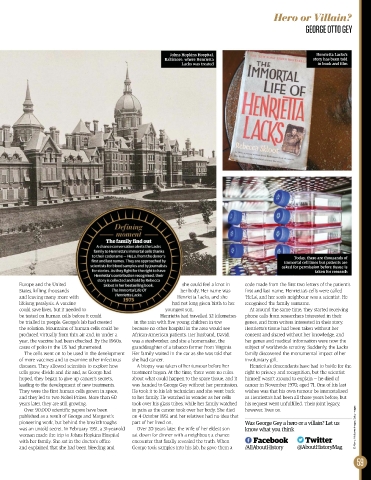
                                                             Johns Hopkins Hospital,                            Henrietta Lacks’s
                                                           Baltimore, where Henrietta                          story has been told
                                                                 Lacks was treated                               in book and film


                                         Defining
                                          moment
                                      The family find out
                                   A chance conversation alerts the Lacks
                                  family to Henrietta’s immortal cells thanks
                                 to their codename — HeLa, from the donor’s                             Today, there are thousands of
                                 first and last names. They are approached by                        immortal cell lines but patients are
                                 scientists for blood samples and by journalists                    asked for permission before tissue is
                                 for stories. As they fight for the right to have                               taken for research
                                  Henrietta’s contribution recognised, their
                                   story is collected and told by Rebecca
        Europe and the United        Skloot in her bestselling book,    she could feel a knot in   code made from the first two letters of the patient’s
        States, killing thousands       The Immortal Life Of    her body. Her name was   first and last name. Henrietta’s cells were called
        and leaving many more with       Henrietta Lacks.      Henrietta Lacks, and she   ‘HeLa’, and her son’s neighbour was a scientist. He
                                            1975
        lifelong paralysis. A vaccine                        had not long given birth to her   recognised the family surname.
        could save lives, but it needed to                 youngest son.                 At around the same time, they started receiving
        be tested on human cells before it could         Henrietta had travelled 32 kilometres   phone calls from researchers interested in their
        be trialled in people. George’s lab had created   in the rain with five young children in tow   genes, and from writers interested in their story.
        the solution. Mountains of human cells could be   because no other hospital in the area would see   Henrietta’s tissue had been taken without her
        produced virtually from thin air and, in under a   African-American patients. Her husband, David,   consent and shared without her knowledge, and
        year, the vaccine had been checked. By the 1960s,   was a steelworker, and she a homemaker, the   her genes and medical information were now the
        cases of polio in the US had plummeted.   granddaughter of a tobacco farmer from Virginia.   subject of worldwide scrutiny. Suddenly, the Lacks
          The cells went on to be used in the development   Her family waited in the car as she was told that   family discovered the monumental impact of her
        of more vaccines and to examine other infectious   she had cancer.             involuntary gift.
        diseases. They allowed scientists to explore how   A biopsy was taken of her tumour before her   Henrietta’s descendants have had to battle for the
        cells grow, divide and die and, as George had   treatment began. At the time, there were no rules   right to privacy and recognition, but the scientist
        hoped, they began to give up cancer’s secrets,   about what could happen to the spare tissue, and it   himself wasn’t around to explain — he died of
        leading to the development of new treatments.   was handed to George Gey without her permission.   cancer in November 1970, aged 71. One of his last
        They were the first human cells grown in space,   He took it to his lab technician and she went back   wishes was that his own tumour be immortalised
        and they led to two Nobel Prizes. More than 60   to her family. He watched in wonder as her cells   as Henrietta’s had been all those years before, but
        years later, they are still growing.   took over his glass tubes, while her family watched   his request went unfulfilled. Their joint legacy,
          Over 90,000 scientific papers have been   in pain as the cancer took over her body. She died   however, lives on.
        published as a result of George and Margaret’s   on 4 October 1951 and her relatives had no idea that
        pioneering work, but behind the breakthroughs   part of her lived on.          Was George Gey a hero or a villain? Let us
        was an untold secret. In February 1951, a 31-year-old   Over 20 years later, the wife of her eldest son   know what you think  © Alamy, Wellcome Images, Getty Images
        woman made the trip to Johns Hopkins Hospital   sat down for dinner with a neighbour; a chance
        with her family. She sat in the doctor’s office   encounter that finally revealed the truth. When   Facebook  Twitter
        and explained that she had been bleeding and   George took samples into his lab, he gave them a   /AllAboutHistory  @AboutHistoryMag
                                                                                                                              59

