


Page 58 - All About History - Issue 53-17
P. 58
Hero or Villain?
        GEORGE O
        JOHN DEETTO GEY


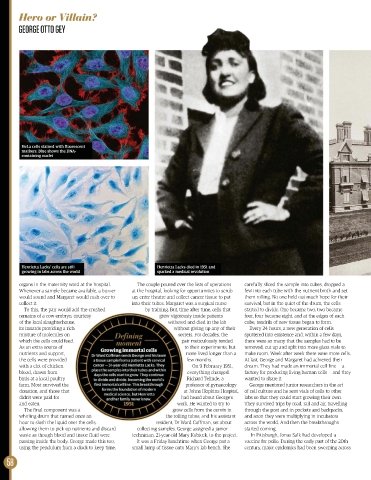
         HeLa cells stained with fluorescent
         markers. Blue shows the DNA-
         containing nuclei


         Henrietta Lacks’ cells are still               Henrietta Lacks died in 1951 and
         growing in labs across the world               sparked a medical revolution

        organs in the maternity ward at the hospital.   The couple poured over the lists of operations   carefully sliced the sample into cubes, dropped a
        Whenever a sample became available, a buzzer   at the hospital, looking for opportunities to scrub   few into each tube with the nutrient broth and set
        would sound and Margaret would rush over to   up, enter theatre and collect cancer tissue to put   them rolling. No one held out much hope for their
        collect it.                            into their tubes. Margaret was a surgical nurse   survival, but in the quiet of the drum, the cells
          To this, the pair would add the crushed   by training. But, time after time, cells that   started to divide. One became two, two became
        remains of a cow embryo, courtesy                grew vigorously inside patients   four, four became eight, and at the edges of each
        of the local slaughterhouse,                        withered and died in the lab   cube, tendrils of new tissue began to form.
        its innards providing a rich                          without giving up any of their   Every 24 hours, a new generation of cells
        mixture of molecules on          Defining               secrets. For decades, the   sputtered into existence and, within a few days,
        which the cells could feed.       moment                 pair meticulously tended   there were so many that the samples had to be
        As an extra source of       Growing immortal cells        to their experiments, but   removed, cut up and split into more glass vials to
        nutrients and support,   Dr Ward Coffman sends George and his team   none lived longer than a   make room. Week after week there were more cells.
        the cells were provided   a tissue sample from a patient with cervical   few months.   At last, George and Margaret had achieved their
        with a clot of chicken    cancer — 31-year-old Henrietta Lacks. They   On 9 February 1951,   dream. They had made an immortal cell line — a
                                 place the samples into their tubes and within
        blood, drawn from         days the cells start to grow. They continue   everything changed.   factory for producing living human cells — and they
        birds at a local poultry   to divide and divide, becoming the world’s   Richard Telinde, a   wanted to share it.
        farm. Most survived the   first immortal cell line. This breakthrough   professor of gynaecology   George mentored junior researchers in the art
        donation, and those that     forms the foundation of modern   at Johns Hopkins Hospital,   of cell culture and he sent vials of cells to other
                                     medical science, but Henrietta
        didn’t were paid for          and her family never knew.  had heard about George’s   labs so that they could start growing their own.
        and eaten.                          1951               work. He wanted to try to   They survived trips by road, rail and air, travelling
          The final component was a                           grow cells from the cervix in   through the post and in pockets and backpacks,
        whirling drum that turned once an                  the rolling tubes, and his assistant   and soon they were multiplying in incubators
        hour to slosh the liquid over the cells,        resident, Dr Ward Coffman, set about   across the world. And then the breakthroughs
        allowing them to pick up nutrients and discard   collecting samples. George assigned a junior   started coming.
        waste as though blood and tissue fluid were   technician, 21-year-old Mary Kubicek, to the project.   In Pittsburgh, Jonas Salk had developed a
        passing inside the body. George made this too,   It was a Friday lunchtime when George put a   vaccine for polio. During the early part of the 20th
        using the pendulum from a clock to keep time.  small lump of tissue onto Mary’s lab bench. She   century, major epidemics had been sweeping across
   58

