


Page 25 - (DK) The Dog Encyclopedia
P. 25
DOGS IN ART AND ADVERTISING


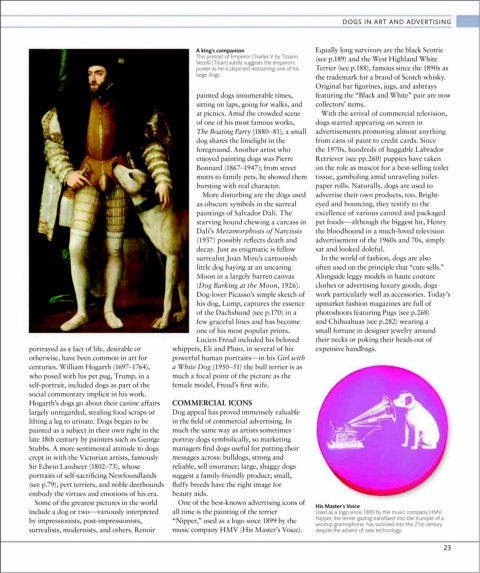
                                                           A king’s companion                  Equally long survivors are the black Scottie
                                                           This portrait of Emperor Charles V by Tiziano   (see p.189) and the West Highland White
                                                           Vecelli (Titian) subtly suggests the emperor’s
                                                           power as he is depicted restraining one of his   Terrier (see p.188), famous since the 1890s as
                                                           large dogs.                         the trademark for a brand of Scotch whisky.
                                                                                               Original bar figurines, jugs, and ashtrays
                                                           painted dogs innumerable times,     featuring the “Black and White” pair are now
                                                           sitting on laps, going for walks, and   collectors’ items.
                                                           at picnics. Amid the crowded scene    With the arrival of commercial television,
                                                           of one of his most famous works,    dogs started appearing on screen in
                                                           The Boating Party (1880–81), a small  advertisements promoting almost anything
                                                           dog shares the limelight in the     from cans of paint to credit cards. Since
                                                           foreground. Another artist who      the 1970s, hundreds of huggable Labrador
                                                           enjoyed painting dogs was Pierre    Retriever (see pp.260) puppies have taken
                                                           Bonnard (1867–1947); from street    on the role as mascot for a best-selling toilet
                                                           mutts to family pets, he showed them  tissue, gamboling amid unraveling toilet-
                                                           bursting with real character.       paper rolls. Naturally, dogs are used to
                                                             More disturbing are the dogs used   advertise their own products, too. Bright-
                                                           as obscure symbols in the surreal   eyed and bouncing, they testify to the
                                                           paintings of Salvador Dali. The     excellence of various canned and packaged
                                                           starving hound chewing a carcass in   pet foods—although the biggest hit, Henry
                                                           Dali’s Metamorphosis of Narcissis   the bloodhound in a much-loved television
                                                           (1937) possibly reflects death and   advertisement of the 1960s and 70s, simply
                                                           decay. Just as enigmatic is fellow   sat and looked doleful.
                                                           surrealist Joan Miro’s cartoonish     In the world of fashion, dogs are also
                                                           little dog baying at an uncaring    often used on the principle that “cute sells.”
                                                           Moon in a largely barren canvas     Alongside leggy models in haute couture
                                                           (Dog Barking at the Moon, 1926).    clothes or advertising luxury goods, dogs
                                                           Dog-lover Picasso’s simple sketch of   work particularly well as accessories. Today’s
                                                           his dog, Lump, captures the essence   upmarket fashion magazines are full of
                                                           of the Dachshund (see p.170) in a   photoshoots featuring Pugs (see p.268)
                                                           few graceful lines and has become   and Chihuahuas (see p.282) wearing a
                                                           one of his most popular prints.     small fortune in designer jewelry around
                                                           Lucien Freud included his beloved   their necks or poking their heads out of
          portrayed as a fact of life, desirable or   whippets, Eli and Pluto, in several of his   expensive handbags.
          otherwise, have been common in art for    powerful human portraits—in his Girl with
          centuries. William Hogarth (1697–1764),    a White Dog (1950–51) the bull terrier is as
          who posed with his pet pug, Trump, in a   much a focal point of the picture as the
          self-portrait, included dogs as part of the   female model, Freud’s first wife.
          social commentary implicit in his work.
          Hogarth’s dogs go about their canine affairs   COMMERCIAL ICONS
          largely unregarded, stealing food scraps or   Dog appeal has proved immensely valuable
          lifting a leg to urinate. Dogs began to be   in the field of commercial advertising. In
          painted as a subject in their own right in the   much the same way as artists sometimes
          late 18th century by painters such as George   portray dogs symbolically, so marketing
          Stubbs. A more sentimental attitude to dogs   managers find dogs useful for putting their
          crept in with the Victorian artists, famously   messages across: bulldogs, strong and
          Sir Edwin Landseer (1802–73), whose       reliable, sell insurance; large, shaggy dogs
          portraits of self-sacrificing Newfoundlands   suggest a family-friendly product; small,
          (see p.79), pert terriers, and noble deerhounds  fluffy breeds have the right image for
          embody the virtues and emotions of his era.  beauty aids.
           Some of the greatest pictures in the world   One of the best-known advertising icons of
                                                                                               His Master’s Voice
          include a dog or two—variously interpreted   all time is the painting of the terrier   Used as a logo since 1899 by the music company HMV,
          by impressionists, post-impressionists,   “Nipper,” used as a logo since 1899 by the   Nipper, the terrier gazing transfixed into the trumpet of a
                                                                                               windup gramophone, has survived into the 21st century
          surrealists, modernists, and others. Renoir   music company HMV (His Master’s Voice).   despite the advent of new technology.


                                                                                                                                     23

