


Page 21 - (DK) The Dog Encyclopedia
P. 21
SKIN AND COAT


          as the Chow Chow (see p.112), this dual layer   attractive dogs, such as the Cocker Spaniel   the dog’s entire body. Natural genetic
          can be immensely thick. With such insulation,  (see p.222) and English Setter (see p.241), have  mutations have resulted in several hairless
          traditional sled dogs of the northern     semi-long coats combining silky-textured   breeds. Dogs like the Xoloitzcuintli (see p.37)
          hemisphere, such as the Greenland Dog (see   body hair of moderate length with longer   and the Chinese Crested (see p.280) have
          p.100) remain impervious to the most bitter   feathering on the tail, underside, and legs.  been around for centuries, but it is only in
          cold. Even the feet of these dogs are protected   Some short-haired dogs have sleek,   modern times that hairlessness has been
          by long hairs between the toes, which also   firm-textured coats that often consist of   deliberately perpetuated by selective
          give them excellent traction on snow and   guard hairs only. The Dalmatian (see p.286)   breeding. Some hairless dogs have
          ice—and adaptations of the blood vessels in   and some pointers and hounds are typical.    a few wisps of hair on the head and feet, and
          the feet (see p.14) help to prevent heat loss, too.  In wire-haired dogs, largely the terrier group,  sometimes a plume on the tail.
           Dogs with extravagantly long hair are bred   the guard hairs are kinked, giving a coarse,   As any owner can testify, all dogs shed
          today for appearance alone, although some   springy texture. These coats are serviceable   a certain amount of hair. Shedding is a
          originally needed their heavy coats for an   in cold weather and stand up well to an   natural seasonal response to the hours of
          outdoor life. For example, the Afghan Hound  energetic terrier lifestyle of digging or delving  daylight, and reaches a peak in the spring
          (see p.136) is a sight hound from the cold,   through undergrowth. Breeds with curly   as the coat thins in readiness for warmer
          high mountains of Afghanistan, and the    coats are uncommon, the best known being   weather. In double-coated dogs, whether
          Bearded Collie (see p.57) has a working   the Poodle (see p.229, 276), sometimes seen   long- or short-haired, hair loss can be
          background as a herding dog. On the other   clipped in fantastic style for the show ring.    considerable as the thick undercoat falls
          hand, the silky, flowing coat of the diminutive  In a few rare breeds, including the Komondor  out. When dogs live largely indoors in
          Yorkshire Terrier (see p.190) has probably   (see p.66) and Puli (see p.65), curls are taken   well-heated houses, the shedding pattern
          always been more decorative than functional,  to extremes, developing into long cords   may change, with the dog losing a little hair
          despite the breed’s long history. Some very   resembling dreadlocks that virtually obscure   throughout the year.


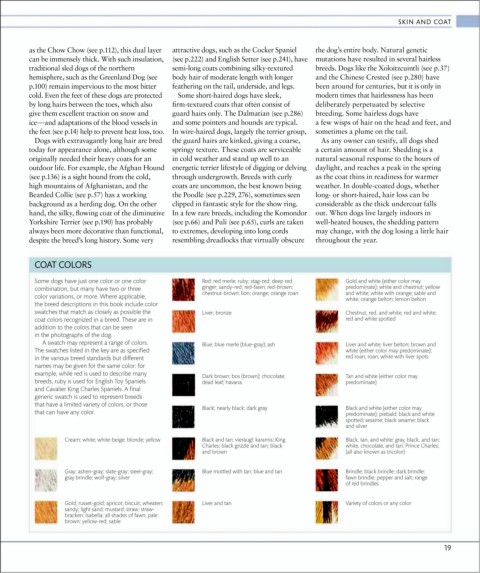
           COAT COLORS

           Some dogs have just one color or one color        Red; red merle; ruby; stag-red; deep red   Gold and white (either color may
           combination, but many have two or three           ginger; sandy-red; red-fawn; red-brown;    predominate); white and chestnut; yellow
                                                             chestnut-brown; lion; orange; orange roan  and white; white with orange; sable and
           color variations, or more. Where applicable,
                                                                                                        white; orange belton; lemon belton
           the breed descriptions in this book include color
           swatches that match as closely as possible the    Liver; bronze                              Chestnut, red, and white; red and white;
           coat colors recognized in a breed. These are in                                              red and white spotted
           addition to the colors that can be seen
           in the photographs of the dog.
                A swatch may represent a range of colors.    Blue; blue merle (blue-gray); ash          Liver and white; liver belton; brown and
           The swatches listed in the key are as specified                                               white (either color may predominate);
           in the various breed standards but different                                                 red roan; roan; white with liver spots
           names may be given for the same color: for
           example, while red is used to describe many       Dark brown; bos (brown); chocolate;        Tan and white (either color may
           breeds, ruby is used for English Toy Spaniels     dead leaf; havana                          predominate)
           and Cavalier King Charles Spaniels. A final
           generic swatch is used to represent breeds
           that have a limited variety of colors, or those    Black; nearly black; dark gray            Black and white (either color may
           that can have any color.                                                                     predominate); piebald; black and white
                                                                                                        spotted; sesame; black sesame; black
                                                                                                        and silver

                    Cream; white; white-beige; blonde; yellow  Black and tan; vieräugl; karamis; King   Black, tan, and white; gray, black, and tan;
                                                             Charles; black grizzle and tan; black      white, chocolate, and tan; Prince Charles;
                                                             and brown                                  (all also known as tricolor)

                    Gray; ashen-gray; slate-gray; steel-gray;    Blue mottled with tan; blue and tan    Brindle; black brindle; dark brindle;
                    gray brindle; wolf-gray; silver                                                     fawn brindle; pepper and salt; range
                                                                                                        of red brindles

                    Gold; russet-gold; apricot; biscuit; wheaten;   Liver and tan                       Variety of colors or any color
                    sandy; light sand; mustard; straw; straw-
                    bracken; Isabella; all shades of fawn; pale
                    brown; yellow-red; sable


                                                                                                                                     19

