


Page 22 - (DK) The Dog Encyclopedia
P. 22
INTRODUCTION TO DOGS  |  DOGS IN RELIGION, MYTH, AND CULTURE


          Dogs in religion,


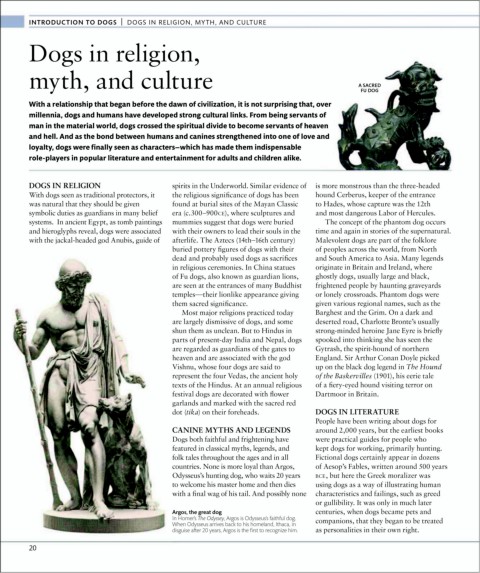
          myth, and culture                                                                                 A SACRED

                                                                                                            FU DOG

          With a relationship that began before the dawn of civilization, it is not surprising that, over
          millennia, dogs and humans have developed strong cultural links. From being servants of
          man in the material world, dogs crossed the spiritual divide to become servants of heaven
          and hell. And as the bond between humans and canines strengthened into one of love and
          loyalty, dogs were finally seen as characters—which has made them indispensable
          role-players in popular literature and entertainment for adults and children alike.


          DOGS IN RELIGION                          spirits in the Underworld. Similar evidence of  is more monstrous than the three-headed
          With dogs seen as traditional protectors, it   the religious significance of dogs has been    hound Cerberus, keeper of the entrance
          was natural that they should be given     found at burial sites of the Mayan Classic   to Hades, whose capture was the 12th
          symbolic duties as guardians in many belief   era (c.300–900CE), where sculptures and   and most dangerous Labor of Hercules.
          systems.  In ancient Egypt, as tomb paintings   mummies suggest that dogs were buried       The concept of the phantom dog occurs
          and hieroglyphs reveal, dogs were associated   with their owners to lead their souls in the   time and again in stories of the supernatural.
          with the jackal-headed god Anubis, guide of   afterlife. The Aztecs (14th–16th century)   Malevolent dogs are part of the folklore
                                                    buried pottery figures of dogs with their   of peoples across the world, from North
                                                    dead and probably used dogs as sacrifices    and South America to Asia. Many legends
                                                    in religious ceremonies. In China statues    originate in Britain and Ireland, where
                                                    of Fu dogs, also known as guardian lions,    ghostly dogs, usually large and black,
                                                    are seen at the entrances of many Buddhist   frightened people by haunting graveyards
                                                    temples—their lionlike appearance giving   or lonely crossroads. Phantom dogs were
                                                    them sacred significance.                   given various regional names, such as the
                                                       Most major religions practiced today    Barghest and the Grim. On a dark and
                                                    are largely dismissive of dogs, and some   deserted road, Charlotte Bronte’s usually
                                                    shun them as unclean. But to Hindus in     strong-minded heroine Jane Eyre is briefly
                                                    parts of present-day India and Nepal, dogs   spooked into thinking she has seen the
                                                    are regarded as guardians of the gates to   Gytrash, the spirit-hound of northern
                                                    heaven and are associated with the god     England. Sir Arthur Conan Doyle picked
                                                    Vishnu, whose four dogs are said to        up on the black dog legend in The Hound
                                                    represent the four Vedas, the ancient holy   of the Baskervilles (1901), his eerie tale
                                                    texts of the Hindus. At an annual religious   of a fiery-eyed hound visiting terror on
                                                    festival dogs are decorated with flower     Dartmoor in Britain.
                                                    garlands and marked with the sacred red
                                                    dot (tika) on their foreheads.             DOGS IN LITERATURE
                                                                                               People have been writing about dogs for
                                                    CANINE MYTHS AND LEGENDS                   around 2,000 years, but the earliest books
                                                    Dogs both faithful and frightening have    were practical guides for people who
                                                    featured in classical myths, legends, and    kept dogs for working, primarily hunting.
                                                    folk tales throughout the ages and in all   Fictional dogs certainly appear in dozens
                                                    countries. None is more loyal than Argos,   of Aesop’s Fables, written around 500 years
                                                    Odysseus’s hunting dog, who waits 20 years   BCE, but here the Greek moralizer was
                                                    to welcome his master home and then dies   using dogs as a way of illustrating human
                                                    with a final wag of his tail. And possibly none  characteristics and failings, such as greed
                                                                                               or gullibility. It was only in much later
                                                    Argos, the great dog                       centuries, when dogs became pets and
                                                    In Homer’s The Odyssey, Argos is Odysseus’s faithful dog.   companions, that they began to be treated
                                                    When Odysseus arrives back to his homeland, Ithaca, in
                                                    disguise after 20 years, Argos is the first to recognize him.   as personalities in their own right.


          20

