


Page 338 - (DK) The Dog Encyclopedia
P. 338
CARE AND TRAINING  |  INHERITED DISORDERS


          Inherited disorders


          An inherited disorder is one that is passed on from one generation to the next.
          Such disorders appear more often in pedigree dogs and may be breed-specific.
           Some common examples are described below.


          THE RISK OF DISEASE                       AORTIC STENOSIS                            Another inherited blood clotting disorder
          Smaller gene pools and widespread inbreeding  A congenital defect, present from birth,   is Von Willebrand’s disease, which affects
          in the past have made pedigree dogs more   aortic stenosis is a narrowing of the aortic   many breeds of either sex. DNA tests are
          likely than crossbreeds to be affected by   valve in the heart. There may be no signs,   available for some breeds.
          inherited disorders. However, although    the disorder being detected as a murmur
          crossbred dogs may be at reduced risk,    when a vet listens to the heart with a     EYE PROBLEMS
          they still have a chance of inheriting    stethoscope at a puppy check. It may be    Dogs can be affected by several inherited eye
          disease-causing genes from either parent.  investigated further (with radiography,   conditions, including some that are easily
                                                    ultrasound, and ECG) or simply monitored,   visible, such as entropion (right), and others
          HIP AND ELBOW DYSPLASIA                   as only a few dogs can be treated surgically.   that need internal examination of the eye
          These two conditions occur mainly in      Some dogs with aortic stenosis go on to    using specialized equipment. An eye disease
          medium-sized and large breeds. In dysplasia,  develop congestive heart failure.      that can occur in any breed and also in
          structural defects either of the hip or the                                          crossbred dogs is progressive retinal atrophy
          elbow cause a joint to become unstable,   BLOOD CLOTTING DISORDERS                   (PRA). In this disorder, there is degeneration
          resulting in pain and lameness. Diagnosis is   The most common inherited clotting    of the retina—the layer of light-sensitive cells
          based on the dog’s history, together with   disorder (in both dogs and humans) is    at the back of the eye—leading to loss of
          joint manipulation and radiography.       hemophilia, in which lack of an essential   vision. An owner may become aware of PRA
           Treatment may consist of pain relief,    factor for blood clotting results in recurrent   when a dog begins to display sight problems,
          reducing exercise, and maintaining ideal   bleeding. The faulty gene responsible is   which at first may be only at night. PRA is
          body weight. Various surgical options are   passed on by affected males to their female   diagnosed from examining the retina with an
          also available, including total hip replacement  offspring, who remain unaffected    ophthalmoscope, and the vet may recommend
          for hip dysplasia. After a set age (generally   themselves but can be carriers of the gene.   more specialized investigations. There is no
          more than one year old), susceptible breeds   Hemophilia can occur in both pedigree and   treatment and loss of vision is permanent.
          can be screened for hip and elbow dysplasia.  crossbred dogs.                        DNA screening is available for some breeds.


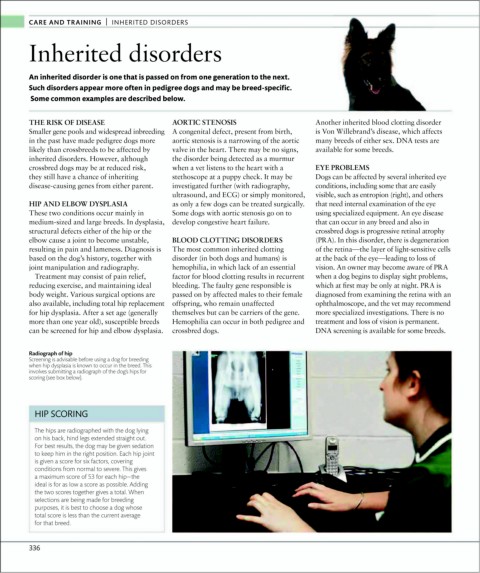
          Radiograph of hip
          Screening is advisable before using a dog for breeding
          when hip dysplasia is known to occur in the breed. This
          involves submitting a radiograph of the dog’s hips for
          scoring (see box below).


           HIP SCORING


           The hips are radiographed with the dog lying
           on his back, hind legs extended straight out.
           For best results, the dog may be given sedation
           to keep him in the right position. Each hip joint
           is given a score for six factors, covering
           conditions from normal to severe. This gives
           a maximum score of 53 for each hip—the
           ideal is for as low a score as possible. Adding
           the two scores together gives a total. When
           selections are being made for breeding
           purposes, it is best to choose a dog whose
           total score is less than the current average
           for that breed.


          336

