


Page 340 - (DK) The Dog Encyclopedia
P. 340
CARE AND TRAINING  |  PARASITES


          Parasites


          Even the most well-groomed dog is susceptible to invasion by skin parasites,
          and it is common, too, for worms to live inside your pet. Prevention of parasites,
          rather than having to treat an infestation and its effects, is the ideal.


          FLEAS                                     system is weakened. Mild demodectic mange   skin of the toes, ears, and around the eyes.
          You need to take year-round preventive    resolves without treatment. Severe cases   These mites rub off easily and usually cause
          action against fleas. Running a flea comb   need specific treatment to kill the mites,   no reaction, but they may be linked to a
          through your dog’s coat, especially over the   which is continued until several skin scrapings  serious disorder called seasonal canine illness.
          rump, may catch fleas, which you can kill    are clear; antibiotics may also be needed if
          by squashing them against the teeth of the   there is an associated skin infection.   LICE
          comb with a finger. You are more likely to   The spiderlike Sarcoptes mite is commonly   A dog that has lice will scratch frequently.
          find flea dirts, which show up as black     passed on to dogs from foxes. It causes the   The lice can be seen in the coat and on the
          debris. Treatment includes spot-on products   highly contagious sarcoptic mange with   skin, with nits (eggs) attached to hairs. The
          (applied at the back of the neck), tablets, and  intense itchiness, hair loss, and skin sores.   entire life cycle of a louse takes place on an
          collars. Alternatively, you can spray, wash,   Your vet will recommend the best treatments.
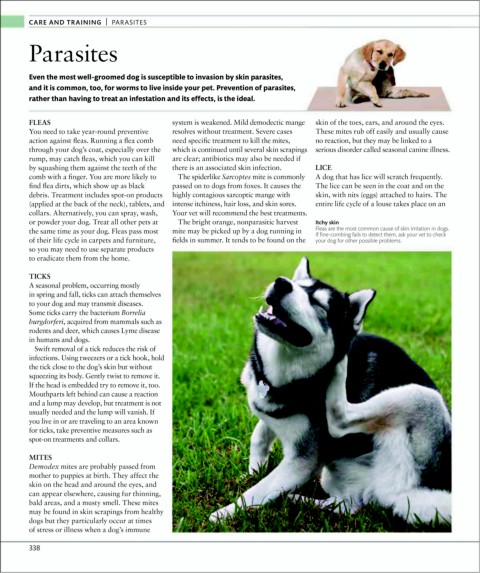
          or powder your dog. Treat all other pets at   The bright orange, nonparasitic harvest   Itchy skin
          the same time as your dog. Fleas pass most   mite may be picked up by a dog running in   Fleas are the most common cause of skin irritation in dogs.
                                                                                               If fine-combing fails to detect them, ask your vet to check
          of their life cycle in carpets and furniture,    fields in summer. It tends to be found on the   your dog for other possible problems.
          so you may need to use separate products
          to eradicate them from the home.

          TICKS
          A seasonal problem, occurring mostly
          in spring and fall, ticks can attach themselves
          to your dog and may transmit diseases.
          Some ticks carry the bacterium Borrelia
          burgdorferi, acquired from mammals such as
          rodents and deer, which causes Lyme disease
          in humans and dogs.
           Swift removal of a tick reduces the risk of
          infections. Using tweezers or a tick hook, hold
          the tick close to the dog’s skin but without
          squeezing its body. Gently twist to remove it.
          If the head is embedded try to remove it, too.
          Mouthparts left behind can cause a reaction
          and a lump may develop, but treatment is not
          usually needed and the lump will vanish. If
          you live in or are traveling to an area known
          for ticks, take preventive measures such as
          spot-on treatments and collars.

          MITES
          Demodex mites are probably passed from
          mother to puppies at birth. They affect the
          skin on the head and around the eyes, and
          can appear elsewhere, causing fur thinning,
          bald areas, and a musty smell. These mites
          may be found in skin scrapings from healthy
          dogs but they particularly occur at times
          of stress or illness when a dog’s immune


          338

