


Page 342 - (DK) The Dog Encyclopedia
P. 342
CARE AND TRAINING  |  NURSING A SICK DOG


          Nursing a sick dog


          There may be times when your dog needs to be nursed because he is sick or
          recovering from surgery and cannot manage things he usually does on his own.
          Follow your vet’s instructions and ask for advice if in doubt.


          HOME CARE AFTER SURGERY
          Dogs are rarely kept in overnight after
          routine operations such as neutering.
          Your vet will give you advice on any specific
          care that is needed, and your dog may be
          discharged with medication such as pain
          relief. If he remains uncomfortable then
          contact the vet.
           Contrary to popular belief, a dog does more
          harm than good if he licks at an undressed
          wound, which will become sore and infected.
          Most dogs accept wearing an Elizabethan
          collar (or E collar)—a large, cone-shaped
          plastic collar that fits around the neck and
          head (above right). Anti-lick strips can also
          deter an inquisitive tongue and stop dogs from
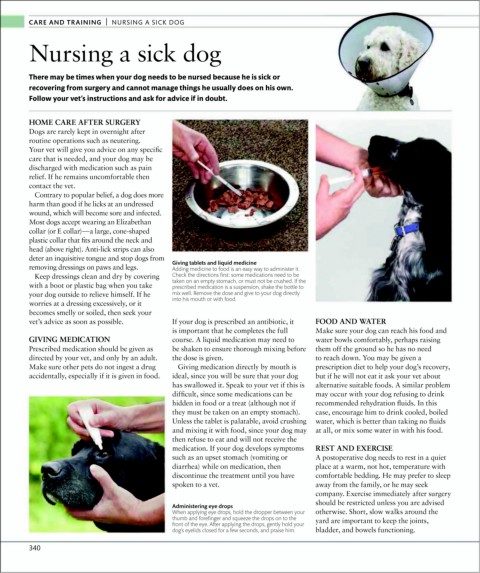
                                                    Giving tablets and liquid medicine
          removing dressings on paws and legs.      Adding medicine to food is an easy way to administer it.
           Keep dressings clean and dry by covering   Check the directions first: some medications need to be
                                                    taken on an empty stomach, or must not be crushed. If the
          with a boot or plastic bag when you take   prescribed medication is a suspension, shake the bottle to
          your dog outside to relieve himself. If he   mix well. Remove the dose and give to your dog directly
                                                    into his mouth or with food.
          worries at a dressing excessively, or it
          becomes smelly or soiled, then seek your
          vet’s advice as soon as possible.         If your dog is prescribed an antibiotic, it    FOOD AND WATER
                                                    is important that he completes the full    Make sure your dog can reach his food and
          GIVING MEDICATION                         course. A liquid medication may need to    water bowls comfortably, perhaps raising
          Prescribed medication should be given as   be shaken to ensure thorough mixing before   them off the ground so he has no need
          directed by your vet, and only by an adult.   the dose is given.                     to reach down. You may be given a
          Make sure other pets do not ingest a drug   Giving medication directly by mouth is   prescription diet to help your dog’s recovery,
          accidentally, especially if it is given in food.   ideal, since you will be sure that your dog   but if he will not eat it ask your vet about
                                                    has swallowed it. Speak to your vet if this is   alternative suitable foods. A similar problem
                                                    difficult, since some medications can be    may occur with your dog refusing to drink
                                                    hidden in food or a treat (although not if   recommended rehydration fluids. In this
                                                    they must be taken on an empty stomach).   case, encourage him to drink cooled, boiled
                                                    Unless the tablet is palatable, avoid crushing  water, which is better than taking no fluids
                                                    and mixing it with food, since your dog may  at all, or mix some water in with his food.
                                                    then refuse to eat and will not receive the
                                                    medication. If your dog develops symptoms   REST AND EXERCISE
                                                    such as an upset stomach (vomiting or      A postoperative dog needs to rest in a quiet
                                                    diarrhea) while on medication, then        place at a warm, not hot, temperature with
                                                    discontinue the treatment until you have   comfortable bedding. He may prefer to sleep
                                                    spoken to a vet.                           away from the family, or he may seek
                                                                                               company. Exercise immediately after surgery
                                                                                               should be restricted unless you are advised
                                                    Administering eye drops
                                                    When applying eye drops, hold the dropper between your   otherwise. Short, slow walks around the
                                                    thumb and forefinger and squeeze the drops on to the   yard are important to keep the joints,
                                                    front of the eye. After applying the drops, gently hold your
                                                    dog’s eyelids closed for a few seconds, and praise him.  bladder, and bowels functioning.


          340

