


Page 346 - (DK) The Dog Encyclopedia
P. 346
CARE AND TRAINING  |  FIRST AID


          CHOKING AND POISONING                     dog may have eaten harmful substances,     effect. However, this is not the case
          It is in a dog’s nature to chew or eat anything   or he has persistent vomiting or diarrhea,   with grapes, both fresh and dried (raisins,
          that looks promising, but this can get him   keep any packaging and immediately      golden raisins, and currants), which
          into trouble, and you will need to act quickly   contact your vet for advice.        are recognized as potential poisons.
          if it does. A dog can choke on all kinds    Take preventive action by always storing
          of objects, including bones, rawhide chews,   anything remotely edible out of reach. This   BITES AND STINGS
          and children’s toys. He may drool or paw   includes all medication, both veterinary and   Dogs are naturally inquisitive, exploring
          frantically at his mouth if the object is   human; antifreeze (ethylene glycol), which   with their noses, so bites and stings from
          wedged in his mouth, and may have difficulty  has a sweet taste but will cause kidney failure;  venomous animals or insects tend to be
          breathing if it is obstructing his airway.  weed killers and slug bait, which are easily   on the head and legs.
           Only attempt to retrieve the object from   found in the yard; and household cleaners   Bees and wasps are a common risk to dogs
          your dog’s mouth if you will not be bitten or  (even if you keep them in an inaccessible   both indoors and outdoors. If your dog is
          there is no risk of pushing it farther into the   cabinet, remember that your dog may drink   stung, move him quickly to prevent further
          throat. Putting something across your dog’s   from a toilet that has a chemical released   stings. Check for insects trapped in your
          jaw to prevent him from closing his mouth is  into the water when flushed).           dog’s coat and look for the site of the sting.
          a good idea if it does not make it harder to   Bait to control rodents should be used and   Bees leave their stinger behind, so remove it
          retrieve the object. Ideally, use something   stored well out of your dog’s reach. Many   carefully with tweezers if you can do this
          rubbery or a pad of material to keep from   rat poisons interfere with the action of   without squeezing the poison sac. Wasps
          damaging his teeth; never use a muzzle.   vitamin K, which is essential to the body’s   can sting repeatedly. Bathe the area with
           If you cannot remove the object, or are   blood-clotting process. This causes internal   baking soda dissolved in water (for bee
          concerned that your dog’s mouth has been   bleeding, which will not become immediately  stings) or with vinegar (for wasp stings),
          damaged, take him straight to a vet.      apparent. If you know or suspect that your   then apply antihistamine cream. Cover the
           If you see your dog swallow something he   dog has eaten rat poison, or a poisoned   area to prevent the dog from licking it. If
          should not, contact your vet for advice. Very  rodent, take the dog straight to the vet and   your dog is in pain or his condition worsens,
          small objects may pass through the dog    bring along any relevant packaging.        take him to the vet. It is an emergency if
          without causing a problem. A larger object   Chocolate is highly appealing to a dog but   your dog has been stung in the mouth or
          may need to be removed, preferably from   is toxic if it has a high cocoa-solid content.   develops a severe allergic reaction (opposite).
          the stomach before it enters the intestines.  Onions and their relatives, including leeks,   Your dog may encounter poisonous toads,
           The most common way for a dog to be      garlic, and scallions, are also poisonous.   which release venom from the skin glands. If
          poisoned is by scavenging something not   Generally, the smaller the dog, the smaller   your dog licks the toad or picks it up, he may
          meant for him. If you are worried that your   the amount of toxin needed to have an   ingest the venom and will react by salivating


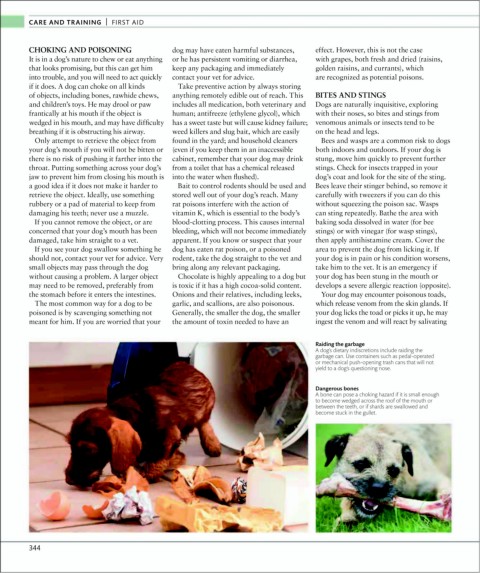
                                                                                               Raiding the garbage
                                                                                               A dog’s dietary indiscretions include raiding the
                                                                                               garbage can. Use containers such as pedal-operated
                                                                                               or mechanical push-opening trash cans that will not
                                                                                               yield to a dog’s questioning nose.


                                                                                               Dangerous bones
                                                                                               A bone can pose a choking hazard if it is small enough
                                                                                               to become wedged across the roof of the mouth or
                                                                                               between the teeth, or if shards are swallowed and
                                                                                               become stuck in the gullet.


          344

