


Page 345 - (DK) The Dog Encyclopedia
P. 345
FIRST AID


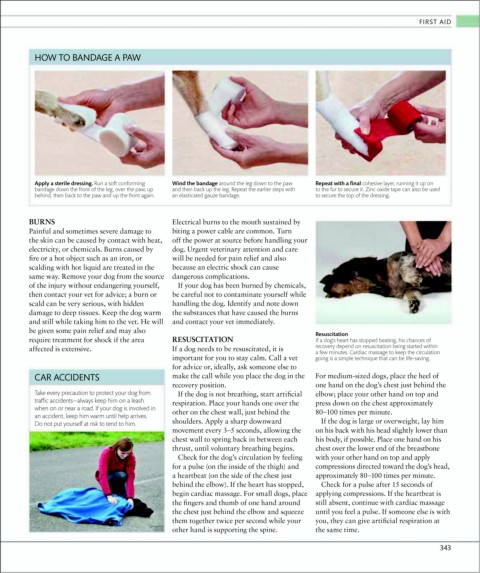
           HOW TO BANDAGE A PAW


           Apply a sterile dressing. Run a soft conforming   Wind the bandage around the leg down to the paw    Repeat with a final cohesive layer, running it up on
           bandage down the front of the leg, over the paw, up   and then back up the leg. Repeat the earlier steps with    to the fur to secure it. Zinc oxide tape can also be used
           behind, then back to the paw and up the front again.   an elasticated gauze bandage.  to secure the top of the dressing.


          BURNS                                     Electrical burns to the mouth sustained by
          Painful and sometimes severe damage to    biting a power cable are common. Turn
          the skin can be caused by contact with heat,   off the power at source before handling your
          electricity, or chemicals. Burns caused by   dog. Urgent veterinary attention and care
          fire or a hot object such as an iron, or   will be needed for pain relief and also
          scalding with hot liquid are treated in the   because an electric shock can cause
          same way. Remove your dog from the source  dangerous complications.
          of the injury without endangering yourself,   If your dog has been burned by chemicals,
          then contact your vet for advice; a burn or   be careful not to contaminate yourself while
          scald can be very serious, with hidden    handling the dog. Identify and note down
          damage to deep tissues. Keep the dog warm   the substances that have caused the burns
          and still while taking him to the vet. He will  and contact your vet immediately.
          be given some pain relief and may also
                                                                                               Resuscitation
          require treatment for shock if the area   RESUSCITATION                              If a dog's heart has stopped beating, his chances of
          affected is extensive.                    If a dog needs to be resuscitated, it is   recovery depend on resuscitation being started within
                                                                                               a few minutes. Cardiac massage to keep the circulation
                                                    important for you to stay calm. Call a vet   going is a simple technique that can be life-saving.
                                                    for advice or, ideally, ask someone else to
           CAR ACCIDENTS                            make the call while you place the dog in the   For medium-sized dogs, place the heel of
                                                    recovery position.                         one hand on the dog’s chest just behind the
           Take every precaution to protect your dog from   If the dog is not breathing, start artificial   elbow; place your other hand on top and
           traffic accidents—always keep him on a leash   respiration. Place your hands one over the   press down on the chest approximately
           when on or near a road. If your dog is involved in
                                                    other on the chest wall, just behind the   80–100 times per minute.
           an accident, keep him warm until help arrives.
           Do not put yourself at risk to tend to him.  shoulders. Apply a sharp downward        If the dog is large or overweight, lay him
                                                    movement every 3–5 seconds, allowing the   on his back with his head slightly lower than
                                                    chest wall to spring back in between each   his body, if possible. Place one hand on his
                                                    thrust, until voluntary breathing begins.  chest over the lower end of the breastbone
                                                      Check for the dog’s circulation by feeling   with your other hand on top and apply
                                                    for a pulse (on the inside of the thigh) and    compressions directed toward the dog’s head,
                                                    a heartbeat (on the side of the chest just   approximately 80–100 times per minute.
                                                    behind the elbow). If the heart has stopped,   Check for a pulse after 15 seconds of
                                                    begin cardiac massage. For small dogs, place  applying compressions. If the heartbeat is
                                                    the fingers and thumb of one hand around    still absent, continue with cardiac massage
                                                    the chest just behind the elbow and squeeze   until you feel a pulse. If someone else is with
                                                    them together twice per second while your   you, they can give artificial respiration at
                                                    other hand is supporting the spine.        the same time.


                                                                                                                                    343

