


Page 344 - (DK) The Dog Encyclopedia
P. 344
CARE AND TRAINING  |  FIRST AID


          First aid


          Dogs are inquisitive by nature and do not understand danger the way we do.
          It is impossible to prevent accidents from happening, so be prepared to
          provide emergency care if your dog is suddenly injured.


          HELPING AN INJURED DOG                     Use adhesive tape rather than safety pins    is stuck in the wound: make sure not to push
          Minor injuries can often be treated at home,   to hold a bandage in place. Be careful not    it in more deeply and do not attempt to
          but if your dog suffers a serious accident he   to apply the bandage too tightly, keep it    remove it yourself.
          must be examined by a veterinarian. If     dry, and change it regularly to check on    For a wound on the chest, apply bandages
          you know the basic rules of first aid, you   the wound. Always seek advice if you notice  soaked in warm saline solution or cooled,
          will be able to provide help until the vet   an offensive smell or if a discharge seeps   boiled water and hold them in place with
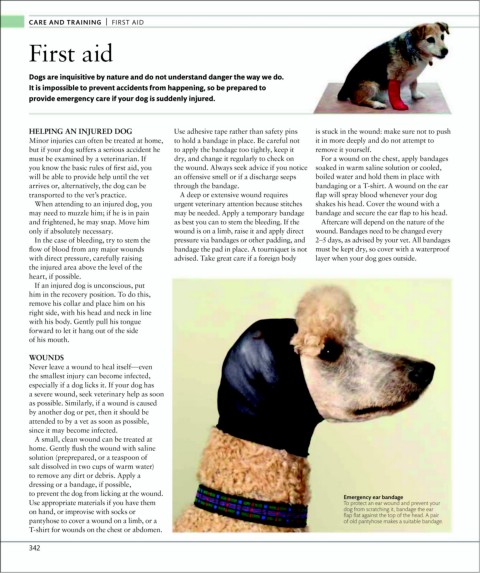
          arrives or, alternatively, the dog can be   through the bandage.                     bandaging or a T-shirt. A wound on the ear
          transported to the vet’s practice.          A deep or extensive wound requires       flap will spray blood whenever your dog
           When attending to an injured dog, you     urgent veterinary attention because stitches   shakes his head. Cover the wound with a
          may need to muzzle him; if he is in pain    may be needed. Apply a temporary bandage   bandage and secure the ear flap to his head.
          and frightened, he may snap. Move him      as best you can to stem the bleeding. If the   Aftercare will depend on the nature of the
          only if absolutely necessary.              wound is on a limb, raise it and apply direct   wound. Bandages need to be changed every
           In the case of bleeding, try to stem the   pressure via bandages or other padding, and   2–5 days, as advised by your vet. All bandages
          flow of blood from any major wounds         bandage the pad in place. A tourniquet is not  must be kept dry, so cover with a waterproof
          with direct pressure, carefully raising    advised. Take great care if a foreign body    layer when your dog goes outside.
          the injured area above the level of the
          heart, if possible.
           If an injured dog is unconscious, put
          him in the recovery position. To do this,
          remove his collar and place him on his
          right side, with his head and neck in line
          with his body. Gently pull his tongue
          forward to let it hang out of the side
          of his mouth.

          WOUNDS
          Never leave a wound to heal itself—even
          the smallest injury can become infected,
          especially if a dog licks it. If your dog has
          a severe wound, seek veterinary help as soon
          as possible. Similarly, if a wound is caused
          by another dog or pet, then it should be
          attended to by a vet as soon as possible,
          since it may become infected.
           A small, clean wound can be treated at
          home. Gently flush the wound with saline
          solution (preprepared, or a teaspoon of
          salt dissolved in two cups of warm water)
          to remove any dirt or debris. Apply a
          dressing or a bandage, if possible,
          to prevent the dog from licking at the wound.
                                                                                                       Emergency ear bandage
          Use appropriate materials if you have them                                                   To protect an ear wound and prevent your
          on hand, or improvise with socks or                                                          dog from scratching it, bandage the ear
                                                                                                       flap flat against the top of the head. A pair
          pantyhose to cover a wound on a limb, or a                                                   of old pantyhose makes a suitable bandage.
          T-shirt for wounds on the chest or abdomen.


          342

