


Page 37 - Shark
P. 37
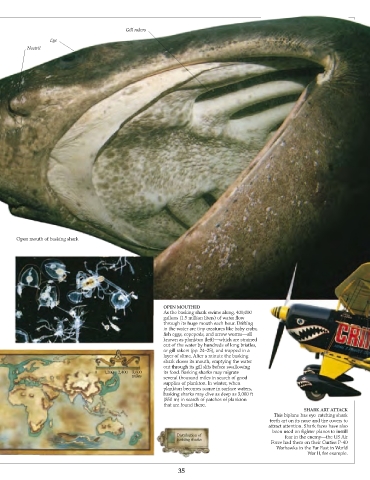
Gill rakers
                  Eye
          Nostril


      Open mouth of basking shark


                                                       Open mOuthed
                                                       As the basking shark swims along, 400,000
                                                       gallons (1.5 million liters) of water flow
                                                       through its huge mouth each hour. Drifting
                                                       in the water are tiny creatures like baby crabs,
                                                       fish eggs, copepods, and arrow worms—all
                                                       known as plankton (left)—which are strained
                                                       out of the water by hundreds of long bristles,
                                                       or gill rakers (pp. 24–25), and trapped in a
                                                       layer of slime. After a minute the basking
                                                       shark closes its mouth, emptying the water
                                                       out through its gill slits before swallowing
                                0  1,200  2,400  3,600  its food. Basking sharks may migrate
                                             miles     several thousand miles in search of good
                                                       supplies of plankton. In winter, when
                                                       plankton becomes scarce in surface waters,
                                                       basking sharks may dive as deep as 3,000 ft
                                                       (850 m) in search of patches of plankton
                                                       that are found there.
                                                                                                      Shark art attack
                                                                                            This biplane has eye-catching shark
                                                                                          teeth art on its nose and tire covers to
                                                                                          attract attention. Shark faces have also
                                                                                           been used on fighter planes to instill
                                                            Distribution of                    fear in the enemy—the US Air
                                                            basking sharks
                                                                                           Force had them on their Curtiss P-40
                                                                                             Warhawks in the Far East in World
                                                                                                       War II, for example.
                                                            35

