


Page 38 - Shark
P. 38
Angel sharks


                             Imagine running a steamroller over a normal-shaped shark—the
                             result would look something like an angel shark. These strange, flattened
                             sharks have extra-large pectoral fins resembling angels’ wings. Angel
                             sharks spend much of their lives resting on the seabed or lying in
                             wait for fish or shellfish to move within reach of their snapping, sharp-
                             toothed jaws. They can also swim, using their tails to propel themselves
                             along, just like other sharks. Angel sharks are most active between dusk
                            and dawn, traveling as far as 6 miles (10 km)
            Monk fish    during the night. There are about 20 species
            Ever since the   of angel shark that live in shallow
            16th century,
            angel sharks   coastal waters around the
            have also been
            called “monk   world to depths of
           fish,” because the   over 3,000 ft
            shape of their
           heads looks like  (1,000 m).
            the hood on a
            monk’s cloak.


              Lower lobe of tail,            Second
               or caudal fin, is               dorsal
               longer than the                   fin
                upper lobe—a
                feature unique                                    0      1,200  2,400  3,600 miles
               to angel sharks                                                               Pelvic fin
                                                                       Distribution
                                                                       of angel sharks


                                  Eye                                                 First dorsal fin
                      Mouth
           Gill              Spiracle
           slit


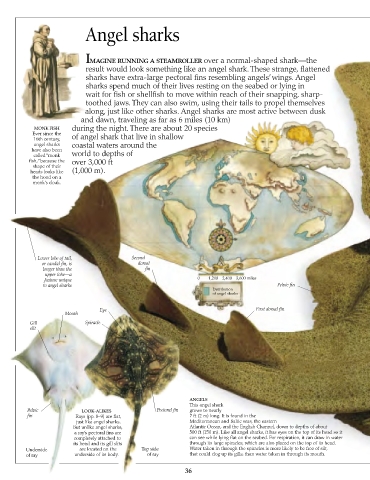
                                                                angeLs
                                                                This angel shark
          Pelvic            Look-aLikes              Pectoral fin  grows to nearly
          fin             Rays (pp. 8–9) are flat,              7 ft (2 m) long. It is found in the
                          just like angel sharks.               Mediterranean and Baltic seas, the eastern
                         But unlike angel sharks,               Atlantic Ocean, and the English Channel, down to depths of about
                          a ray’s pectoral fins are             500 ft (150 m). Like all angel sharks, it has eyes on the top of its head so it
                          completely attached to                can see while lying flat on the seabed. For respiration, it can draw in water
                         its head and its gill slits            through its large spiracles, which are also placed on the top of its head.
          Underside        are located on the   Top side        Water taken in through the spiracles is more likely to be free of silt,
          of ray          underside of its body.  of ray        that could clog up its gills, than water taken in through its mouth.
                                                              36

