


Page 192 - (DK Eyewitness) Travel Guide - South Africa
P. 192
190 THE WESTERN AND SOUTHERN C APE
Whale-Watching
Some 37 whale and dolphin species and around 100 different
types of shark occur in southern African waters. Only a small Alexander
Bay
number come in close to the coast, however. Of the dolphins, Durban
bottlenose, common and Heaviside’s are the most prolific, Lambert’s WILD COAST
Bay
while common predatory sharks include the great white, Cape Plettenberg
Bay
tiger, ragged-tooth, oceanic white tip, bull (Zambezi) and Agulhas
mako. A large portion of the world’s 4,000–6,000 southern Whale-Watching
right whales migrates north annually, with numbers Best vantage points
increasing by seven per cent every year. They leave their
subantarctic feeding grounds from June onwards to mate
and calve in the warmer waters of the protected rocky bays
and inlets that occur along the South African coastline. An albino calf was born in
Hermanus in 1997.
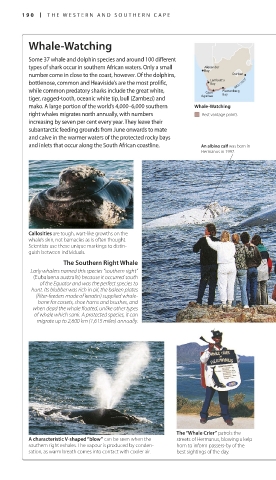
Callosities are tough, wartlike growths on the
whale’s skin, not barnacles as is often thought.
Scientists use these unique markings to distin
guish between individuals.
The Southern Right Whale
Early whalers named this species “southern right”
(Eubalaena australis) because it occurred south
of the Equator and was the perfect species to
hunt. Its blubber was rich in oil, the baleen plates
(filter-feeders made of keratin) supplied whale-
bone for corsets, shoe horns and brushes, and
when dead the whale floated, unlike other types
of whale which sank. A protected species, it can
migrate up to 2,600 km (1,615 miles) annually.
The “Whale Crier” patrols the
A characteristic V-shaped “blow” can be seen when the streets of Hermanus, blowing a kelp
southern right exhales. The vapour is produced by conden horn to inform passersby of the
sation, as warm breath comes into contact with cooler air. best sightings of the day.
190-191_EW_South_Africa.indd 190 25/05/17 2:46 pm

