


Page 193 - (DK Eyewitness) Travel Guide - South Africa
P. 193
INTRODUCING THE WESTERN AND SOUTHERN C APE 191
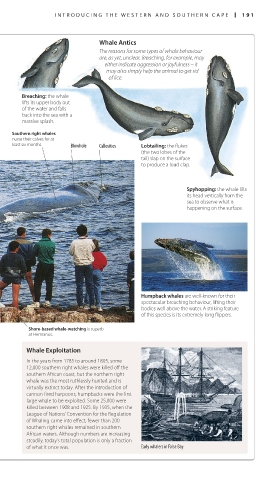
Whale Antics
The reasons for some types of whale behaviour
are, as yet, unclear. Breaching, for example, may
either indicate aggression or joyfulness – it
may also simply help the animal to get rid
of lice.
Breaching: the whale
lifts its upper body out
of the water and falls
back into the sea with a
massive splash.
Southern right whales
nurse their calves for at
least six months. Blowhole Callosities Lobtailing: the flukes
(the two lobes of the
tail) slap on the surface
to produce a loud clap.
Spyhopping: the whale lifts
its head vertically from the
sea to observe what is
hap pening on the surface.
Humpback whales are well-known for their
spectacular breaching behaviour, lifting their
bodies well above the water. A striking feature
of this species is its extremely long flippers.
Shore-based whale-watching is superb
at Hermanus.
Whale Exploitation
In the years from 1785 to around 1805, some
12,000 southern right whales were killed off the
southern African coast, but the northern right
whale was the most ruthlessly hunted and is
virtually extinct today. After the intro duction of
cannon-fired harpoons, humpbacks were the first
large whale to be exploited. Some 25,000 were
killed between 1908 and 1925. By 1935, when the
League of Nations’ Convention for the Regulation
of Whaling came into effect, fewer than 200
southern right whales remained in southern
African waters. Although numbers are increasing
steadily, today’s total population is only a fraction
of what it once was. Early whalers in False Bay
190-191_EW_South_Africa.indd 191 25/05/17 2:46 pm

