


Page 309 - (DK Eyewitness) Travel Guide - South Africa
P. 309
INTRODUCING GA UTENG , LIMPOPO AND MPUM ALANGA 307
The Great Limpopo
Transfrontier Park
This cross-border initiative links the Kruger
National Park in South Africa, Limpopo National
Park in Mozambique, and Gonarezhou National
Park, Manjinji Pan Sanctuary and Malipati Safari
Area in Zimbabwe, into one huge conservation
area covering 37,700 sq km (14,556 sq miles) –
roughly the same size as the Netherlands.
By taking down the fences along the country
borders, which also divided conservation areas,
the habitat available to the wildlife has been
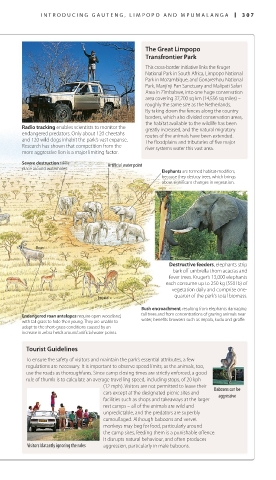
Radio tracking enables scientists to monitor the greatly increased, and the natural migratory
endangered predators. Only about 120 cheetahs routes of the animals have been extended.
and 120 wild dogs inhabit the park’s vast expanse. The floodplains and tributaries of five major
Research has shown that competition from the river systems water this vast area.
more aggres sive lion is a major limiting factor.
Severe destruction takes Artificial water point
place around waterholes.
Elephants are termed habitat-modifiers,
because they destroy trees, which brings
about significant changes in vegetation.
Roan
Destructive feeders, elephants strip
bark off umbrella thorn acacias and
fever trees. Kruger’s 13,000 elephants
each consume up to 250 kg (550 lb) of
vegetation daily and comprise one-
Impala quarter of the park’s total biomass.
Bush encroachment, resulting from elephants damag ing
tall trees and from concentrations of grazing animals near
Endangered roan antelopes require open woodland,
with tall grass to hide their young. They are unable to water, benefits browsers such as impala, kudu and giraffe.
adapt to the short-grass conditions caused by an
increase in zebra herds around artificial water points.
Tourist Guidelines
To ensure the safety of visitors and maintain the park’s essential attributes, a few
regulations are necessary. It is important to observe speed limits, as the animals, too,
use the roads as thoroughfares. Since camp closing times are strictly enforced, a good
rule of thumb is to calculate an average travel ling speed, including stops, of 20 kph
(12 mph). Visitors are not permitted to leave their Baboons can be
cars except at the designated picnic sites and aggressive
facilities such as shops and takeaways at the larger
rest camps – all of the animals are wild and
unpredictable, and the predators are superbly
camouflaged. Although baboons and vervet
monkeys may beg for food, particularly around
the camp sites, feeding them is a punishable offence.
It disrupts natural behaviour, and often produces
Visitors blatantly ignoring the rules aggression, particularly in male baboons.
306-307_EW_South_Africa.indd 307 25/05/17 2:47 pm

