


Page 310 - (DK Eyewitness) Travel Guide - South Africa
P. 310
308 GA UTENG , LIMPOPO AND MPUM ALANGA
Gold Mining
Vast natural resources make South Africa one of the richest Johannesburg
countries on the continent. Ancient sediments in this
geological treasure chest yield silver, platinum, chromite,
uranium, dia monds – and gold. Over the years, small-scale Cape Town
miners have left behind evidence of their labour all around
the country. The most poignant of these historic sites is
Pilgrim’s Rest (see p336), a well-preserved mining town Extent of Gold Fields
in Mpuma langa. Today, South Africa is the world’s sixth- Main mining operations
largest gold producer, and the industry is controlled by
giant corporations.
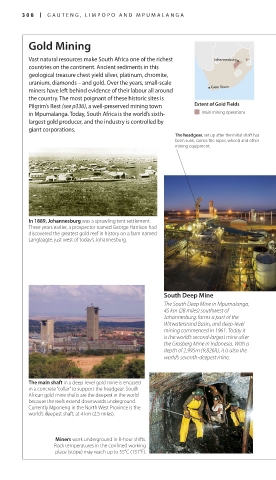
The headgear, set up after the initial shaft has
been sunk, carries the ropes, wheels and other
mining equipment.
In 1889, Johannesburg was a sprawling tent settlement.
Three years earlier, a prospector named George Harrison had
discovered the greatest gold reef in history on a farm named
Langlaagte, just west of today’s Johannesburg.
South Deep Mine
The South Deep Mine in Mpumalanga,
45 km (28 miles) southwest of
Johannesburg, forms a part of the
Witwatersrand Basin, and deep-level
mining commenced in 1961. Today it
is the world’s second-largest mine after
the Grasberg Mine in Indonesia. With a
depth of 2,995m (9,826ft), it is also the
world’s seventh-deepest mine.
The main shaft in a deep-level gold mine is encased
in a concrete “collar” to support the headgear. South
African gold-mine shafts are the deepest in the world
because the reefs extend downwards underground.
Currently Mponeng in the North West Province is the
world’s deepest shaft, at 4 km (2.5 miles).
Miners work underground in 8-hour shifts.
Rock temperatures in the confined working
place (stope) may reach up to 55°C (131°F).
308-309_EW_South_Africa.indd 308 25/05/17 2:47 pm

