


Page 311 - (DK Eyewitness) Travel Guide - South Africa
P. 311
INTRODUCING GA UTENG , LIMPOPO AND MPUM ALANGA 309
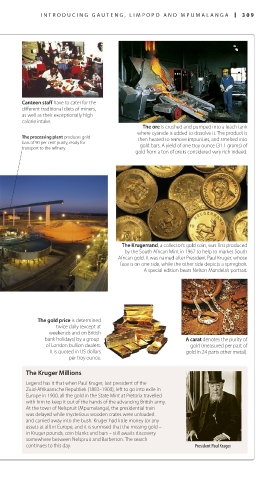
Canteen staff have to cater for the
different traditional diets of miners,
as well as their exceptionally high
calorie intake.
The ore is crushed and pumped into a leach tank
where cyanide is added to dissolve it. The product is
The headgear, set up after the initial shaft has The processing plant produces gold
been sunk, carries the ropes, wheels and other bars of 90 per cent purity, ready for then heated to remove impurities, and smelted into
mining equipment. transport to the refinery. gold bars. A yield of one troy ounce (31.1 grams) of
gold from a ton of ore is considered very rich indeed.
The Krugerrand, a collector’s gold coin, was first produced
by the South African Mint in 1967 to help to market South
African gold. It was named after President Paul Kruger, whose
face is on one side, while the other side depicts a springbok.
A special edition bears Nelson Mandela’s portrait.
The gold price is determined
twice daily (except at
weekends and on British
bank holidays) by a group A carat denotes the purity of
of London bullion dealers. gold (measured per part of
It is quoted in US dollars gold in 24 parts other metal).
per troy ounce.
The Kruger Millions
Legend has it that when Paul Kruger, last president of the
Zuid-Afrikaansche Republiek (1883–1900), left to go into exile in
Europe in 1900, all the gold in the State Mint at Pretoria travelled
with him to keep it out of the hands of the advancing British army.
At the town of Nelspruit (Mpumalanga), the presidential train
was delayed while mysterious wooden crates were unloaded
and carried away into the bush. Kruger had little money (or any
assets at all) in Europe, and it is surmised that the missing gold –
in Kruger pounds, coin blanks and bars – still awaits discovery
somewhere between Nelspruit and Barberton. The search
continues to this day. President Paul Kruger
308-309_EW_South_Africa.indd 309 25/05/17 2:47 pm

