Page 66 - Fish and Amphibians (Britannica Illustrated Science Library)
P. 66
62 AMPHIBIANS                                                                                                                                                                                          FISH AND AMPHIBIANS 63


          Distant Kin                                                                                                                                            SCALES             Acanthostega

                                                                                                                                                                 They had scales all
                                                                                                                                                                  over their body,  lived some 360 million years ago. It is
                                                                                                                                                                    just like fish.   considered one of the first amphibians, even
                he first amphibians evolved from fish with fleshy, lobed fins that resembled legs.                              TAIL                                                though it was not well adapted to land and lived
                                                                                                                                Still has the
                They may have been attracted to land as a source for food, but the most important                               form of a fish fin                                  mainly in water. It had gills, like fish, even  Oar-
                                                                                                                                                                                    though it probably also had lungs. Its legs
                                                                                                                                                                                                                                  shaped
          T reason for their leaving the water was the instability of the Devonian Period, which                                                                                    were well developed, but they were            tail
                                                                                                                                                                                    not yet fit for moving on land.
          drastically affected freshwater environments. During long droughts, the fish used their
          fleshy fins to move from one pond to another. Oxygen availability was also affected, and
          this led to more organisms being able to breathe oxygen from the air.
                                                                                                                                                                                     Cranial
                                                                                                                                                                                     postorbital
                                                                                                                                                                                     bone
                                                                                                                                                                                                                         Mobile vertebrae
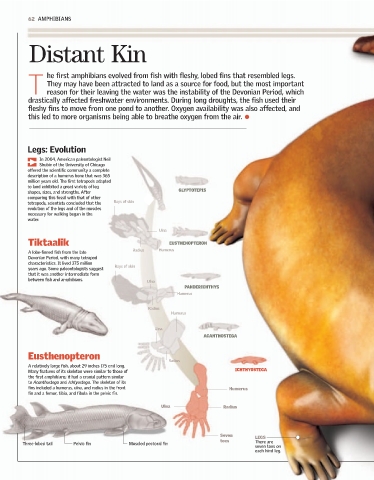
          Legs: Evolution                                                                                                                                                                                                strengthened its
                                                                                                                                                                                                                         spine.
              In 2004, American paleontologist Neil
              Shubin of the University of Chicago
          offered the scientific community a complete
          description of a humerus bone that was 365                                                                                                               Prefrontal                                                  Eight toes
          million years old. The first tetrapods adapted                                                                                                           bone
          to land exhibited a great variety of leg
                                                          GLYPTOTEPIS
          shapes, sizes, and strengths. After
          comparing this fossil with that of other
          tetrapods, scientists concluded that the  Rays of skin
          evolution of the legs and of the muscles                                                                                                                                                             Pelvic          Pectoral
          necessary for walking began in the                                                                                                                                                                   girdle          girdle
          water.
                                                    Ulna
                                                                                                                                                    The Skeleton
          Tiktaalik                                    EUSTHENOPTERON                                                                                   In the steps from their first aquatic habitat
                                            Radius  Humerus                                                                                             to land, the first amphibians had many  ACANTHOSTEGA        Spinal Column
          A lobe-finned fish from the late                                                                                                          characteristics in common with fish, such as a                  becomes a solid  Jaws
          Devonian Period, with many tetrapod                                                                                                                                                                       structure with
                                                                                                                                                    typically wide tail. They looked clumsy, with short
          characteristics. It lived 375 million                                                                                                                                                                     articulated vertebrae.
                                      Rays of skin                                                                                                  limbs. The first four-legged animals had no
          years ago. Some paleontologists suggest
                                                                                                                                                    competition on land. Everything that is needed to
          that it was another intermediate form                                                                                                     live on land has its evolutionary roots in fish.  Spinal Column
          between fish and amphibians.          Ulna                                                                                                                                             becomes an axis
                                                                                                                                                                                                 that supports the
                                                            PANDERICHTHYS                                                                                                                        entire weight of
                                                                                                                                                                                                 the body.
                                                          Humerus
                                                                                                                                                                      HEAD
                                                                                                                                                                      Its structure retains
                                                 Radius                                                                                                               the opercular bones.
                                                        Humerus
                                                                                                                                                                                           ICHTHYOSTEGA                            Jaws
                                                                                                                                                                                                        Pelvic Girdle  Ribs  Pectoral
                                                   Ulna                                                                                                                                                 The pelvic and pectoral  girdle
                                                                                                                                                                                                        girdles are strengthened
                                                                  ACANTHOSTEGA                                                                                                                          compared with those of
                                                                                                                                                                                                        its predecessor.
          Eusthenopteron
                                                       Radius
          A relatively large fish, about 29 inches (75 cm) long.
                                                                             ICHTHYOSTEGA
          Many features of its skeleton were similar to those of
          the first amphibians; it had a cranial pattern similar
          to Acanthostega and Ichtyostega. The skeleton of its
          fins included a humerus, ulna, and radius in the front           Humerus
          fin and a femur, tibia, and fibula in the pelvic fin.
                                                                                                                                                                                                                          39 inches
                                                                                                                                                                                                                          (100 cm)
                                                     Ulna                Radius
                                                                                                                                                                                                                 ICHTHYOSTEGA
                                                                                                                                                                                                                 Scientific
                                                                                                                                                                                                                 name      Ichthyostegopsis
                                                                                                                                                                                                                 Lived     360 million years ago
                                                                        Seven      LEGS
                                                                        toes       There are                                                                                                                     Location  Greenland
        Three-lobed tail  Pelvic fin      Muscled pectoral fin
                                                                                   seven toes on                                                                                                                 Length    Up to 3.3 feet (1 m)
                                                                                   each hind leg.
   61   62   63   64   65   66   67   68   69   70   71