


Page 68 - Fish and Amphibians (Britannica Illustrated Science Library)
P. 68
64 AMPHIBIANS FISH AND AMPHIBIANS 65
Between Land and Water Differences SKIN EYES EYES SKIN
The skin of a toad is
The pupil is usually
Soft and smooth,
Frogs have
wrinkled, hard,
horizontal, though
with strong,
horizontal
Between Frogs
also used as leather.
vertical pupils.
and Toads bright colors pupils. some toads have rough, and dry. It is
s indicated by their name (amphi, “both,” and bios, “life”), these animals lead a double life.
It is very common to use “frog” and “toad” COMMON TOAD
When young, they live in the water, and when they become adults they live outside it. In as synonyms or to think that the frog is a Bufo bufo
A any case, many must remain near water or in very humid places to keep from drying out. female toad. However, frogs and toads are
quite different. Toads have wrinkled skin
This is because amphibians also breathe through their skin, and only moist skin can absorb and short legs, and they are land animals.
oxygen. Some typical characteristics of adult frogs and toads include a tailless body, long Frogs are smaller, have webbed feet,
and live in the water and in trees.
hind limbs, and large eyes that often bulge.
REED FROG
Amphibian Anatomy Hyperolius tuberilinguis
VOCAL SACS
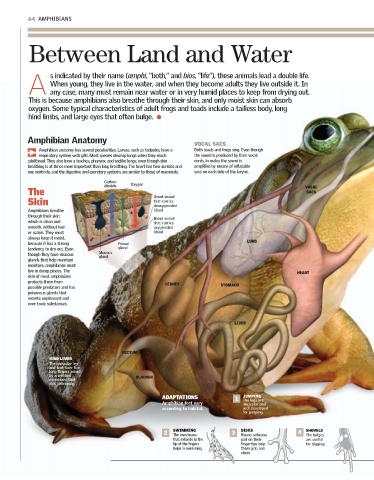
Amphibian anatomy has several peculiarities. Larvae, such as tadpoles, have a Both toads and frogs sing. Even though
respiratory system with gills. Most species develop lungs when they reach the sound is produced by their vocal POSTURE
Toads are terrestrial species,
adulthood. They also have a trachea, pharynx, and saclike lungs, even though skin cords, in males the sound is slow-moving and wider than LEGS
breathing is at times more important than lung breathing. The heart has two auricles and amplified by means of inflatable frogs. Frogs live mainly in are long and are LEGS
one ventricle, and the digestive and excretory systems are similar to those of mammals. sacs on each side of the larynx. water, which is why they adapted for jumping. are shorter and wider
than those of frogs and
have webbed toes adapted
Frogs have webbed toes
for swimming. to help with swimming. are adapted for walking.
Carbon
dioxide Oxygen VOCAL
The SACS
Blood vessel
Skin that carries
deoxygenated
Amphibians breathe blood
through their skin, Nutrition
Blood vessel
which is clean and that carries
smooth, without hair oxygenated CATCHING is based on plants during the larval
or scales. They must blood Toads gulp stage, whereas in the adult stage the
down their
always keep it moist, prey, main food sources are arthropods (such as
because it has a strong Poison LUNG swallowing insects of the order Coleoptera and
it whole.
tendency to dry out. Even gland arachnids) and other invertebrates, such as
Mucous
though they have mucous butterfly caterpillars and earthworms.
gland SWALLOWING
glands that help maintain Eye retraction, where the
moisture, amphibians must toad closes and turns its
live in damp places. The eyes inward, increases the
HEART pressure in the mouth,
skin of most amphibians pushing food down the
protects them from esophagus.
KIDNEY STOMACH
possible predators and has
poisonous glands that Types of Amphibians EUROPEAN TREE FROG RINGED CAECILIAN
secrete unpleasant and 1 is docile and lives near looks like a large, 2
even toxic substances. Amphibians are divided into three buildings. thick worm.
groups that are differentiated on the ANURA APODA
basis of tail and legs. Newts and Tailless Without legs
salamanders have tails. They belong to the
LIVER
order Urodela. Frogs and toads, which have
no tail except as tadpoles, belong to the
Anura group. Caecilians, which have no tail
or legs, are similar to worms and belong to
the Apoda group.
RECTUM
HIND LIMBS
The muscular leg
and foot have five
long fingers joined
by a webbed BLADDER
membrane that
aids swimming.
ADAPTATIONS 1 JUMPING
The legs are
Amphibian feet vary muscular and Legs
according to habitat. well developed Frogs and toads have four fingers on each
for jumping.
front leg and five on each hind leg. Water
frogs have webbed feet; tree frogs have
adhesive disks on the tips of their fingers
2 SWIMMING 3 DISKS 4 SHOVELS to hold on to vertical surfaces; and
The membrane Round adhesive The bulges
that extends to the pad on their are useful burrowing frogs have callous TIGER SALAMANDER
tip of the fingers fingertips help for digging. protuberances called tubercules on their One of the most 3 URODELA
helps in swimming. them grip and hind legs, which they use for digging. colorful in America With a tail
climb.

