


Page 74 - Fish and Amphibians (Britannica Illustrated Science Library)
P. 74
70 AMPHIBIANS FISH AND AMPHIBIANS 71
Metamorphosis Mother Frog and Her Eggs
Cycle Despite the fact that the survival instinct of anurans is not fully
developed, frogs and toads somehow take care of their future young.
etamorphosis is the process of transformation experienced by anurans (it can also be Laying eggs in great quantities ensures that many tadpoles will be able to
observed in amphibians from the order Urodela and caecilians) starting with the egg and METAMORPHOSIS escape predators who feed on the eggs. The gelatinous layer also protects
The development of the common the eggs from other predators. Some frogs even care for their tadpoles by
M ending at the adult stage. When they leave the egg, amphibians have a larval form. They European frog from egg to adult nestling them on their backs. An example of such a frog is the Surinam toad.
then undergo very important changes in their anatomy, diet, and lifestyle, slowly mutating from their takes approximately 16 weeks.
first stage, which is completely aquatic, until they transform into animals adapted to life on land.
EDIBLE FROG
Rana esculenta
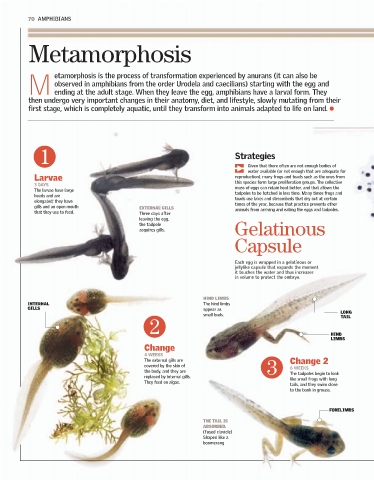
1 Strategies
Given that there often are not enough bodies of
water available (or not enough that are adequate for
Larvae reproduction), many frogs and toads such as the ones from
this species form large proliferation groups. The collective
3 DAYS
mass of eggs can retain heat better, and that allows the
The larvae have large
tadpoles to be hatched in less time. Many times frogs and
heads and are
elongated; they have toads use lakes and streambeds that dry out at certain
times of the year, because that practice prevents other
gills and an open mouth EXTERNAL GILLS
that they use to feed. Three days after animals from arriving and eating the eggs and tadpoles.
leaving the egg,
the tadpole
acquires gills. Gelatinous
Capsule
Each egg is wrapped in a gelatinous or
jellylike capsule that expands the moment
it touches the water and thus increases
in volume to protect the embryo.
HIND LIMBS
INTERNAL The hind limbs
GILLS appear as
LONG
small buds. 6
TAIL
2
HIND Change 2
LIMBS READY
Change Adult frogs meet at the pond's
4 WEEKS CHANGED 5 bank before abandoning the
water for the first time, which
The external gills are Change 2 HEART they do as a group.
covered by the skin of 3 6 WEEKS BULGING
the body, and they are The tadpoles begin to look EYES
replaced by internal gills.
like small frogs with long Change 2
They feed on algae.
tails, and they swim close 16 WEEKS
4 hind limbs and protruding eyes.
to the bank in groups. The tadpole has well-developed
Very little of its tail remains to
be absorbed.
FORELIMBS
Change 2 FINGERS
THE TAIL IS 9 WEEKS Frogs have
ABSORBED. A tissue has divided the atrium (one four toes on
(Fused clavicle) of the parts of the heart), resulting their forefeet
Shaped like a in a three-chamber heart, which and five on
boomerang helps with the movement of blood REMAINDER their hind
between the heart and the lungs. OF THE TAIL feet.

