


Page 14 - BBC Wildlife Volume 36 #06
P. 14
WILD JUNE


                                               et’s start with the bad news: during  needed. Fortunately, this decline is finally
                                                                                 n
                                                                                 being reversed thanks to the current trend
                                               the 20th century, half of our ponds
                   MIKE                    Ldisappeared. Many of these miniature  b
                                                                                 of installing water features in gardens.
                                                                                 o
               DILGER                       wetlands in the countryside were lost to  The creation of ponds has mimicked the
                                            urban development, while others were either  a age-old process of natural pond formation,
                                                                                 w
                                            drained, filled in, or simply deteriorated due
                                                                                 which now rarely happens in the intensively
              WILDLIFE                      to neglect. As ponds support two thirds of  m
                                                                                 managed landscapes of modern Britain. The
                                                                                 aquatic real estate currently found in many
                                            all freshwater creatures, urgent action was
                                                                                 a
                                                                                 gardens, in addition to bringing aesthetic value,
          WATCHING                                                               g
                                                                                 has become vital for a range of freshwater
                                                                                 species that may be struggling in rural areas.
                                                                                   As most of the above water action will be
                         In  a  pond                                             of the insectivorous kind, watching ponds is
                         In a pond
                                                                                 best conducted on a warm, sunny day when
             A hive of activity above and
           below water, and even on the
          water’s surface itself, ponds are
         easily accessible and one of our
           most diverse wildlife habitats.


           DILGER’S  DOS
            AND DON’TS
              Don’t FORGET
            THAT PONDS CAN
            BE POTENTIALLY
           DANGEROUS PLACES,
             so young children
            must never be left
           unattended near them.
            Do REMEMBER THE
             GOLDEN RULE of
             pond dipping: put
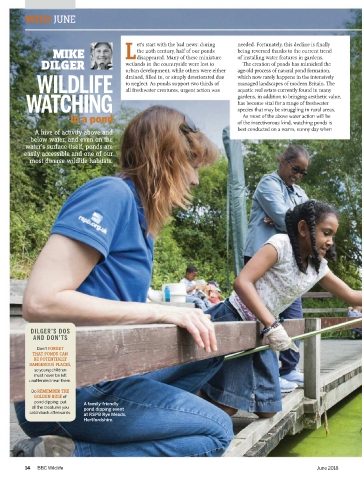
                             A family-friendly
            all the creatures you
                             pond dipping event
           catch back afterwards.
                             at RSPB Rye Meads,
                             Hertfordshire.


          14  BBC Wildlife                                                                                  June 2018

