


Page 16 - BBC Wildlife Volume 36 #06
P. 16
WILD NEWS


                                                                     RIES
         DISCOVER


                                                                                                        Written by
                                                                                                        STUART
                                                                           dom.
          The latest in scientific research from all over the animal king   d                            BLACKMAN
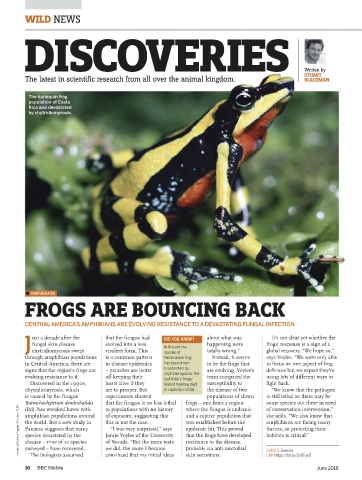
           The harlequin frog
           population of Costa
           Rica was devastated
           by chytridiomycosis.


          Q AMPHIBIANS
          FROGS ARE BOUNCING BACK


          CENTRAL AMERICA’S AMPHIBIANS ARE EVOLVING RESISTANCE TO A DEVASTATING FUNGAL INFECTION

                                                                                             It’s not clear yet whether the
         J  ust a decade after the   that the fungus had  DID YOU KNOW?  about what was    frogs’ response is a sign of a
                                                                       happening were
                                     evolved into a less
            fungal skin disease
                                                         Q At least one
                                                                       totally wrong.”
                                     virulent form. This
                                                                                           global recovery. “We hope so,”
         Jchytridiomycosis swept
          through amphibian populations  is a common pattern  species of  Instead, it seems  says Voyles. “We were only able
                                                         Panamanian frog
          in Central America, there are  in disease epidemics  has been driven  to be the frogs that  to focus on one aspect of frog
          signs that the region’s frogs are  – parasites are better  to extinction by  are evolving. Voyles’s  defences but we expect they’re
                                                         chytridiomycosis.The
          evolving resistance to it.  off keeping their                team compared the   using lots of different ways to
                                                         last Rabb’s fringe-
           Discovered in the 1990s,  hosts alive if they  limbed treefrog died  susceptibility to  fight back.
          chytridiomycosis, which    are to prosper. But  in captivity in 2016.  the disease of two  “We know that the pathogen
          is caused by the fungus    experiments showed                populations of clown  is still lethal so there may be
          Batrachochytrium dendrobatidis  that the fungus is no less lethal  frogs – one from a region  some species out there in need
       Michae & Patricia Fogden/Minden/FLPA  the world. But a new study in  this is not the case.  was established before the  amphibians are facing many
                                     to populations with no history
          (Bd), has wreaked havoc with
                                                                                           of conservation intervention,”
                                                                where the fungus is endemic
                                                                                           she adds. “We also know that
                                                                and a captive population that
                                     of exposure, suggesting that
          amphibian populations around
          Panama suggests that many
                                                                                           threats, so protecting their
                                      “I was very surprised,” says
                                                                epidemic hit. This proved
                                                                                           habitats is critical.”
          species devastated by the
                                                                that the frogs have developed
                                     Jamie Voyles of the University
          disease – nine of 12 species
                                     of Nevada. “But the more tests
                                                                resistance to the disease,
          surveyed – have recovered.
                                     we did, the more I became
                                                                probably via anti-microbial
                                                                                             K
                                                                                           LINK https://bit.ly/2vOFyeO
              BBC Wildlife
          16 The biologists assumed  convinced that my initial ideas  skin secretions.     SOURCE Science   June 2018

