


Page 15 - BBC Wildlife Volume 36 #06
P. 15
WILD JUNE
COMING UP
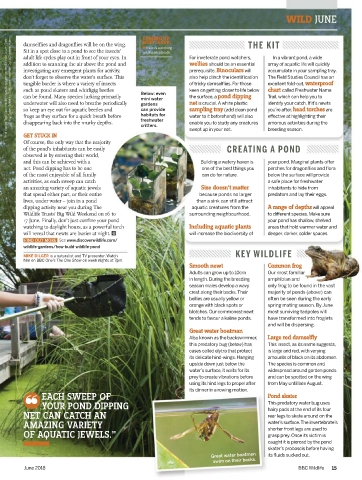
Pond dipping: Tom Mason/rspb-images.com; water garden: Eric Van Lokven/Getty; frog: Oxford Scientific/Getty; water boatman: David Chapman/Alamy adult life cycles play out in front of your eyes. In Below: even For inveterate pond watchers, array of aquatic life will quickly
NEXT ISSUE:
THE
KIT
damselflies and dragonflies will be on the wing.
O Mike is watching
Sit in a spot close to a pond to see the insects’
wildlife on a heath
In a vibrant pond,a wide
addition to scanning the air above the pond and
wellies should be an essential
investigating any emergent plants for activity,
prerequisite.Binoculars will
accumulate in your sampling tray.
don’t forget to observe the water’s surface. This
also help clinch the identification
The Field Studies Council has an
excellent fold-out,waterproof
tangible border is where a variety of insects
of tricky damselflies.For those
such as pond skaters and whirligig beetles
keen on getting closer to life below
chart called Freshwater Name
the surface,apond dipping
can be found. Many species lurking primarily
Trail,which can help you to
mini water
t
underwater will also need to breathe periodically
identify your catch.If it’s newts
net is crucial.Awhite plastic
gardens
y
s
so keep an eye out for aquatic beetles and
you’re after,head torches are
can provide
sampling tray (add clean pond
habitats for
frogs as they surface for a quick breath before
disappearing back into the murky depths.
t
s
t
s
o
ou
amor
amorous activities during the
amor
during
ou
y
y
cr
cr
y
e
atur
atur
e
y
s
s
o
tudy
an
an
tudy
ous
ous
enable
enable you to study any creaturess
t
the
enable
activitie
he
activitie
during
critters.
breeding season.
swept up in your net.
GET STUCK IN
Of course, the only way that the majority freshwater water to it beforehand) will also e e s efective at highlighting their
P
of the pond’s inhabitants can be easily CREATING A OND
observed is by entering their world,
and this can be achieved with a Building a watery haven is your pond. Marginal plants ofer
net. Pond dipping has to be one one of the best things you perches for dragonflies and flora
of the most enjoyable of all family can do for nature. below the surface will provide
activities, as each sweep can catch a safe place for freshwater
an amazing variety of aquatic jewels Size doesn’t matter inhabitants to hide from
that spend either part, or their entire because ponds no larger predators and lay their eggs.
lives, under water – join in a pond than a sink can still attract
s
dipping activity near you during The aquatic creatures from the A range of depths will appeal
Wildlife Trusts’ Big Wild Weekend on 16 to surrounding neighbourhood. to diferent species.Make sure
17 June. Finally, don’t just confine your pond your pond has shallow,shelved
watching to daylight hours, as a powerful torch Including aquatic plants areas that hold warmer water and
will reveal that newts are busier at night. will increase the biodiversity of deeper,darker,colder spaces.
FIND OUT MORE See www.discoverwildlife.com/
wildlife-gardens/how-build-wildlife-pond
KEY WILDLIFE
MIKE DILGER is a naturalist and TV presenter. Watch
him on BBC One’s The One Show on week nights at 7pm.
w
Smooth newt Common frog
Adults can grow up to 10cm Our most familiar
in length.During the breeding amphibian and
season males develop a wavy only frog to be found in the vast
crest along their backs.Their majority of ponds (above) can
bellies are usually yellow or often be seen during the early
orange with black spots or spring mating season. By June
blotches.Our commonest newt most surviving tadpoles will
tends to favour alkaline ponds. have transformed into froglets
and will be dispersing.
Great water boatman
Also known as the backswimmer, Large red damselfly
this predatory bug (below) has This insect,as its name suggests,
cases called elytra that protect is large and red,with varying
its delicate hind-wings.Hanging amounts of black on its abdomen.
upside down just below the The species is common and
water’s surface,it waits for its widespread around garden ponds
prey to create vibrations before and can be spotted on the wing
using its hind legs to propel after from May until lateAugust.
its dinner in a rowing motion.
P
EACH SWEEP OF Pond skater
T
` YOUR POND DIPPING This predatory water bug uses
hairy pads at the end of its four
h
NET CAN CATCH AN r rear legs to skate around on the
w
AMAZING VARIETY water’s surface.The invertebrate’s
s
shorter front legs are used to
OF AQUATIC JEWELS.” grasp prey Once its victim isis
e
nc
it
victim
s
pr
e
gr g g
asp
y
.
O
c caught it is pierced by the pond
skater’s proboscis before having
s
Great water boatmen its fluids sucked out.
i
swim on their backs.
June 2018 BBC Wildlife 15

