


Page 17 - BBC Wildlife Volume 36 #06
P. 17
WILD NEWS


         Q BEHAVIOUR
                                                                                              The
         LOOK                                                                                 EXPLAINE
         SMART                                                                                6FLHQWLĶF WHUPV SXW LQWR SODLQ

         Being clever is an advantage                                                         (QJOLVK IRU WKH UHVW RI XV
         in life. But for ring-tailed
       Lemurs: Bernard Castelein/naturepl.com; roof: D ane Cook And Len Jenshe /Getty; malleefowl: Michael Pitts/naturepl.com; ant: Heinz Wiesbauer/AAAS/Creat veCommons
         lemurs, it’s also advantageous                                                       PHILOPATRY AND
         to be seen to be clever.                                                             DISPERSAL
           New research has shown                                                             Just as some humans are
         that lemurs that worked out                                                          homebodies while others
         how to extract food hidden                                                           have wanderlust, animals
         in apparatus received social                                                         vary in their inclination to
         favours from others that had                                                         travel or stay put. Among
         watched them do it.                                                                  mammals, for example,
           “I was quite impressed                                                             males tend to disperse
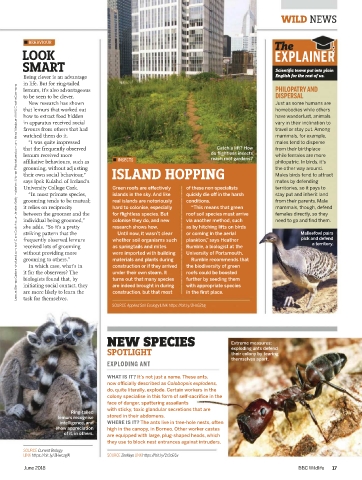
         that the frequently observed                                     Catch a lift? How   from their birthplace
         lemurs received more                                           do flightless insects   while females are more
                                                                        reach roof gardens?
         affiliative behaviours, such as  Q INSECTS                                           philopatric. In birds, it’s
         grooming, without adjusting                                                          the other way around.
         their own social behaviour,”  ISLAND HOPPING                                         Males birds tend to attract
         says Ipek Kulahci of Ireland’s                                                       mates by defending
         University College Cork.      Green roofs are effectively  of these non-specialists  territories, so it pays to
           “In most primate species,   islands in the sky. And like  quickly die off in the harsh  stay put and inherit land
         grooming tends to be mutual;  real islands are notoriously  conditions.              from their parents. Male
         it relies on reciprocity      hard to colonise, especially  “This means that green   mammals, though, defend
         between the groomer and the   for flightless species. But  roof soil species must arrive  females directly, so they
         individual being groomed,”    colonise they do, and new  via another method, such    need to go and find them.
         she adds. “So it’s a pretty   research shows how.      as by hitching lifts on birds
         striking pattern that the       Until now, it wasn’t clear  or coming in the aerial           Malleefowl pairs
         frequently observed lemurs    whether soil organisms such  plankton,” says Heather            pick and defend
                                                                                                           a territory.
         received lots of grooming     as springtails and mites  Rumble, a biologist at the
         without providing more        were imported with building  University of Portsmouth.
         grooming to others.”          materials and plants during  Rumble recommends that
           In which case, what’s in    construction or if they arrived  the biodiversity of green
         it for the observers? The     under their own steam. It  roofs could be boosted
         biologists found that, by     turns out that many species  further by seeding them
         initiating social contact, they  are indeed brought in during  with appropriate species
         are more likely to learn the  construction, but that most  in the first place.
         task for themselves.
                                       SOURCE Applied Soil Ecology LINK https://bit.ly/2Hs62bg


                                     NEW SPECIES                               Extreme measures:

                                     SPOTLIGHT                                 exploding ants defend
                                                                               their colony by tearing
                                                                               themselves apart.
                                     EXPLODING ANT
                                     WHAT IS IT? It’s not just a name. These ants,
                                     now oicially described as Colobopsis explodens,
                                     do, quite literally, explode. Certain workers in the
                                     colony specialise in this form of self-sacrifice in the
                                     face of danger, spattering assailants
                                     with sticky, toxic glandular secretions that are
                         Ring-tailed
                     lemurs recognise   stored in their abdomens.
                     intelligence, and   WHERE IS IT? The ants live in tree-hole nests, often
                    show appreciation   high in the canopy, in Borneo. Other worker castes
                       of it, in others.   are equipped with large, plug-shaped heads, which
                                     they use to block nest entrances against intruders.
         SOURCE Current Biology
         LINK https://bit.ly/2HwczgW  SOURCE ZooKeys LINKhttps://bit.ly/2r2oE6v
         June 2018                                                                                    BBC Wildlife  17

