


Page 33 - BBC Wildlife Volume 36 #06
P. 33
ASIAN ELEPHANTS


          are used to from their captive lives,” says Jack. “If we were to
          suddenly just leave them unchained they would panic.” Once
          they have spent short periods without restraint at night there
          will be a gradual lengthening of those chains during the day
          – about a metre at a time, until they feel comfortable being
          further apart from their companions. It will be a very gradual
          re-education process. Baby steps for a huge beast.

          CHANGING ATTITUDES
          Eventually the plan is for the sanctuary to have three
          locations; the current site is not big enough for the elephants
          to live without some human interaction. So although it is
          fine for the first stages of rehabilitation, another much larger
                                                 2
          site will be needed for stage two. This will be a 1–1.5km
          area with 2km between feeding locations. Tourism (without
          the stress-inducing rides and washing sessions) helps fund
          the majority of the sanctuary’s work, so in this case a jeep
          safari will bring the important visitors to see the elephants
          in this semi-wild location. Stage three will be to create as
          close to a wild environment as possible. The land needed
                                     2
          for this would have to be around 16km  so it would operate
          on a similar basis to a national park, with minimal human   CASE HISTORY KA MOON
          contact. The whole process is expected to take 10 years and
          will be funded by private investment.             Age Approximately        Suitable for release?
           Attitudes to elephants in Thailand are gradually changing.   50–60 years  Yes. She has very little learned
          Farmers close to the boundaries of national parks (where   Origin Mae Hong Song   behaviour compared to the
          most of Thailand’s truly wild elephants now live) are still   province, Myanmar border  others in the sanctuary,
          experiencing crop raiding, but fewer animals are now being   Job Trekking elephant  and is showing signs of re-
          killed as a result. Kui Buri National Park, for instance, has   Distinctive features White   learning natural behaviour
          a healthy population of elephants – around 237 at the last   scar on forehead, most likely   quickly considering her poor
          count. On the border with Myanmar, it is a place where the   from the use of a bullhook  condition on arrival.
          elephants are free to roam. On the Thai side it is fringed by
          farmland, where pineapple and rubber plantations exist.
          To prevent elephants straying from the park, ditches have
          been dug around the edge and grasses that the elephants
          enjoy have been planted to try and dissuade them from
          leaving to find food in the neighbouring farms.
           This has only been partially successful. As one local
          farmer, Tia explained, “The elephants just love pineapples


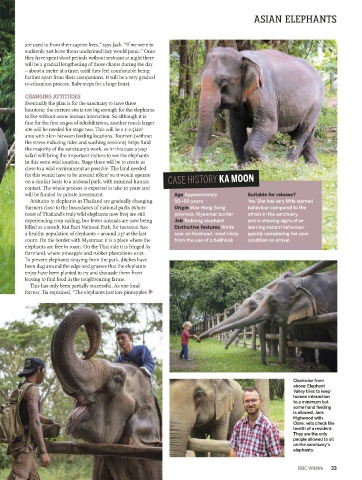
                                                                                                    Clockwise from
                                                                                                    above: Elephant
                                                                                                    Valley tries to keep
                                                                                                    human interaction
                                                                                                    to a minimum but
                                                                                                    some hand feeding
                                                                                                    is allowed; Jack
                                                                                                    Highwood with
                                                                                                    Clare; vets check the
                                                                                                    health of a resident.
                                                                                                    They are the only
                                                                                                    people allowed to sit
                                                                                                    on the sanctuary’s
                                                                                                    elephants.

                                                                                                      BBC Wildlife  33

