


Page 32 - BBC Wildlife Volume 36 #06
P. 32
Jack’s 10 years of experience in running an elephant
                                                            cl linic and sanctuary in Cambodia has taught him that,
                                                            if f the elephants are not ridden or unduly handled,
                                                            th
                                                             hey begin to feel less stressed, resulting in a return to
                                                            more natural behaviour. This success has led him to
                                                            m
                                                            c ontemplate one step further: to rehabilitate some of
                                                            h
                                                            his charges so they can return to the wild.
                                                              The new Thailand project was set up with
                                                            t his goal in mind from the beginning. After the
                                                            sanctuary’s neighbours were convinced that no
                                                            s
                                                             e
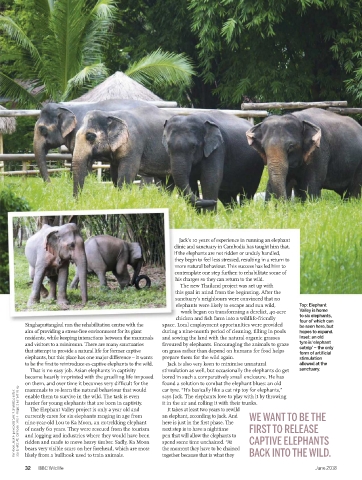
                                                             elephants were likely to escape and run wild,  Top: Elephant
                                                              work began on transforming a derelict, 40-acre  Valley is home
                                                                                                      to six elephants,
                                                             c
                                                             chicken and fish farm into a wildlife-friendly
                                                                                                      four of which can
          Singhaputtangkul run the rehabilitation centre with the  space. Local employment opportunities were provided  be seen here, but
          aim of providing a stress-free environment for its giant  during a nine-month period of cleaning, filling in pools  hopes to expand.
          residents, while keeping interactions between the mammals  and sowing the land with the natural organic grasses  Inset: an old
          and visitors to a minimum. There are many sanctuaries  favoured by elephants. Encouraging the animals to graze  tyre is‘elephant
                                                                                                      catnip’– the only
          that attempt to provide a natural life for former captive  on grass rather than depend on humans for food helps
                                                                                                      form of artificial
          elephants, but this place has one major difference – it wants  prepare them for the wild again.  stimulation
          to be the first to reintroduce ex-captive elephants to the wild.  Jack is also very keen to minimise unnatural  allowed at the
           That is no easy job. Asian elephants in captivity  stimulation as well, but occasionally the elephants do get  sanctuary.
          become heavily imprinted with the gruelling life imposed  bored in such a comparatively small enclosure. He has
          on them, and over time it becomes very difficult for the  found a solution to combat the elephant blues: an old
       ey mage: E ephant Va  mammals to re-learn the natural behaviour that would  car tyre. “It’s basically like a cat nip toy for elephants,”
      Ka Moon, Jack H ghwood & tyre: R chard Ecc eston;  ; ma n  Campbe  currently cares for six elephants ranging in age from  an elephant, according to Jack. And  WEWANTTO BETHE
          enable them to survive in the wild. The task is even
                                                        says Jack. The elephants love to play with it by throwing
                                                        it in the air and rolling it with their trunks.
          harder for young elephants that are born in captivity.
           The Elephant Valley project is only a year old and
                                                          It takes at least two years to rewild
                                                        here is just in the first phase. The
          nine-year-old Lou to Ka Moon, an ex-trekking elephant
                                                                                     FIRSTTO RELEASE
          of nearly 60 years. They were rescued from the tourism
                                                        next step is to have a nighttime
                                                        pen that will allow the elephants to
          and logging and industries where they would have been
                                                                                     CAPTIVE ELEPHANTS
       boy & vets: Ab
                                                        spend some time unchained. “At
          ridden and made to move heavy timber. Sadly, Ka Moon
          bears very visible scars on her forehead, which are most
          likely from a bullhook used to train animals.
                                                        together because that is what they
                                                                                                            June 2018
          32  BBC Wildlife                              the moment they have to be chained  BACK INTOTHEWILD.

