


Page 28 - BBC Wildlife Volume 36 #06
P. 28
WATER VOLES


          FOSSORIAL WATER VOLE FIELD SIGNS


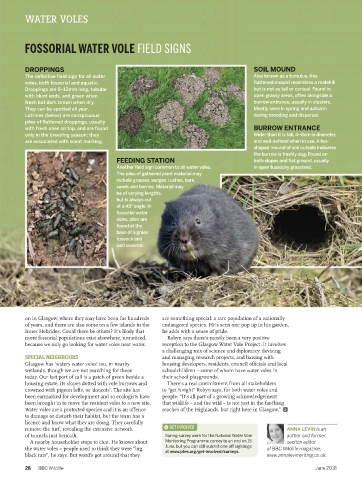
          DROPPINGS                                                                    SOIL MOUND
          The definitive field sign for all water                                      Also known as a tumulus, this
          voles, both fossorial and aquatic.                                           flattened mound resembles a molehill
          Droppings are 8–12mm long, tubular                                           but is not as tall or conical. Found in
          with blunt ends, and green when                                              open grassy areas, often alongside a
          fresh but dark brown when dry.                                               burrow entrance, usually in clusters.
          They can be spotted all year.                                                Mostly seen in spring and autumn
          Latrines (below) are conspicuous                                             during breeding and dispersal.
          piles of flattened droppings, usually
          with fresh ones on top, and are found                                        BURROW ENTRANCE
          only in the breeding season; they                                            Wider than it is tall, 4–8cm in diameter,
          are associated with scent marking.                                           and well-defined when in use. A fan-
                                                                                       shaped mound of soil outside indicates
                                                                                       the burrow is freshly dug. Found on
                                        FEEDING STATION                                both slopes and flat ground, usually
                                        Another field sign common to all water voles.   in open tussocky grassland.
                                        The piles of gathered plant material may
                                        include grasses, sedges, rushes, bark,
                                        seeds and berries. Material may
                                        be of varying lengths,
                                        but is always cut
                                        at a 45° angle. In
                                        fossorial water
                                        voles, piles are
                                        found at the
                                        base of a grass
                                        tussock and
                                        well covered.


          on in Glasgow, where they may have been for hundreds   are something special: a rare population of a nationally
          of years, and there are also some on a few islands in the   endangered species. He’s seen one pop up in his garden,
          Inner Hebrides. Could there be others? It’s likely that   he adds with a sense of pride.
          more fossorial populations exist elsewhere, unnoticed,   Robyn says there’s mostly been a very positive
          because we only go looking for water voles near water.  reception to the Glasgow Water Vole Project. It involves
                                                        a challenging mix of science and diplomacy: devising
          SPECIAL NEIGHBOURS                            and managing research projects, and liaising with
          Glasgow has ‘watery water voles’ too, in nearby    housing developers, residents, council officials and local
          wetlands, though we are not searching for those   schoolchildren – some of whom have water voles in
          today. Our last port of call is a patch of green beside a   their school playgrounds.
          housing estate, its slopes dotted with vole burrows and   There’s a real commitment from all stakeholders
          crowned with pigeon lofts, or ‘doocots’. The site has   to “get it right” Robyn says, for both water voles and
          been earmarked for development and so ecologists have   people. “It’s all part of a growing acknowledgement
          been brought in to move the resident voles to a new site.   that wildlife – and the wild – is not just in the far-flung
          Water voles are a protected species and it is an offence   reaches of the Highlands, but right here in Glasgow.”
          to damage or disturb their habitat, but the team has a
          licence and know what they are doing. They carefully
          remove the turf, revealing the extensive network    +  GET INVOLVED                     ANNA LEVIN is an
          of tunnels just beneath.                       Spring survey work for the National Water Vole  author and former
           A nearby householder stops to chat. He knows about   Monitoring Programme comes to an end on 15  section editor
                                                         June, but you can still submit one-of sightings
          the water voles – people used to think they were “big,                           of BBC Wildlife magazine;
                                                         at www.ptes.org/get-involved/surveys.
          black rats”, he says. But word’s got around that they                            www.annalevinwriting.co.uk.
          28  BBC Wildlife                                                                                  June 2018

