


Page 56 - BBC Wildlife Volume 36 #06
P. 56
Last year I saw my first

         cuckoo ray at Arran for 30

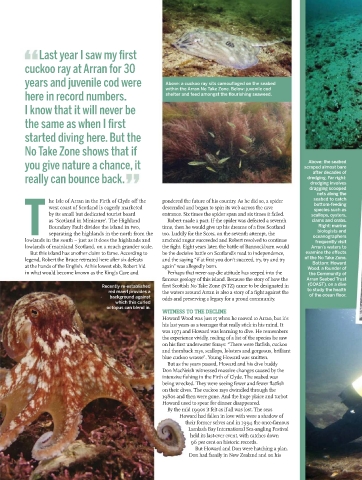
         years and juvenile cod were                     Above: a cuckoo ray sits camouflaged on the seabed
                                                         within the Arran No Take Zone. Below: juvenile cod
         here in record numbers.                         shelter and feed amongst the flourishing seaweed.

         I know that it will never be

         the same as when I first

         started diving here.But the

         No Take Zone shows that if

                                                                                                         Above: the seabed
         you give nature a chance,it                                                                    scraped almost bare
                                                                                                           after decades of
         really can bounce back.                                                                         dredging. Far right:
                                                                                                          dredging involves
                                                                                                          dragging scooped
                                                                                                            nets along the
                  he Isle of Arran in the Firth of Clyde off the  pondered the future of his country. As he did so, a spider  seabed to catch
                                                                                                           bottom-feeding
                  west coast of Scotland is eagerly marketed  descended and began to spin its web across the cave
                                                                                                           species such as
                  by its small but dedicated tourist board  entrance. Six times the spider span and six times it failed.  scallops, oysters,
                  as ‘Scotland in Miniature’. The Highland  Robert made a pact. If the spider was defeated a seventh  clams and crabs.
                  Boundary Fault divides the island in two,  time, then he would give up his dreams of a free Scotland  Right: marine
                                                                                                            biologists and
         T separating the highlands in the north from the  too. Luckily for the Scots, on the seventh attempt, the
                                                                                                           oceanographers
          lowlands in the south – just as it does the highlands and  arachnid augur succeeded and Robert resolved to continue  frequently visit
          lowlands of mainland Scotland, on a much grander scale.  the fight. Eight years later, the battle of Bannockburn would  Arran’s waters to
           But this island has another claim to fame. According to  be the decisive battle on Scotland’s road to independence,  examine the effects
          legend, Robert the Bruce retreated here after six defeats  and the saying “if at first you don’t succeed, try, try and try  of the No Take Zone.
                                                                                                           Bottom: Howard
          at the hands of the English. At his lowest ebb, Robert hid  again” was allegedly born.
                                                                                                         Wood, a founder of
          in what would become known as the King’s Cave and  Perhaps that never-say-die attitude has seeped into the  the Community of
                                                        famous geology of this island. Because the story of how the  Arran Seabed Trust
                                   Recently re-established   first Scottish No Take Zone (NTZ) came to be designated in  (COAST), on a dive
                                      red maerl provides a   the waters around Arran is also a story of a fight against the  to study the health
                                      background against   odds and preserving a legacy for a proud community.  of the ocean floor.
                                        which this curled
                                     octopus can blend in.
                                                        WITNESS TO THE DECLINE
                                                        Howard Wood was just 15 when he moved to Arran, but it’s
                                                        his last years as a teenager that really stick in his mind. It
                                                        was 1973 and Howard was learning to dive. He remembers
                                                        the experience vividly, reeling of a list of the species he saw
                                                        on his first underwater forays: “There were flatfish, cuckoo
                                                        and thornback rays, scallops, lobsters and gorgeous, brilliant
                                                        blue cuckoo wrasse”. Young Howard was smitten.
                                                          But as the years passed, Howard and his dive buddy
                                                        Don MacNeish witnessed massive changes caused by the
                                                        intensive fishing in the Firth of Clyde. The seabed was
                                                        being wrecked. They were seeing fewer and fewer flatfish
                                                        on their dives. The cuckoo rays dwindled through the
                                                        1980s and then were gone. And the huge plaice and turbot
                                                        Howard used to spear for dinner disappeared.
                                                          By the mid 1990s it felt as if all was lost. The seas
                                                              Howard had fallen in love with were a shadow of
                                                                their former selves and in 1994 the once-famous
                                                                 Lamlash Bay International Sea-angling Festival
                                                                 held its last-ever event, with catches down
                                                                  96 per cent on historic records.
                                                                   But Howard and Don were hatching a plan.
                                                                 Don had family in New Zealand and on his

