


Page 57 - BBC Wildlife Volume 36 #06
P. 57
LAMLASH BAY


                                                                       visits there he had been to the world’s first ever NTZ,
                                                                       a marine reserve established in 1975 around Goat Island.
                                                                       What Don saw astonished him and sowed the seed of an
                                                                       idea that he and Howard thought could work back home.
                                                                       In 1995, The Community of Arran Seabed Trust, or   Boat: Scotland:The B g Picture/NPL; marine
                                                                       COAST, was born – a community-led group whose sole
                                                                       aim was to fight for a similar zone around Lamlash Bay
                                                                       on the east shore of Arran.
                                                                         For Howard, the most important people to get to support
                                                                       the project were the local fishermen. “Arran’s fishermen
                                                                       knew that their livelihoods depended on a healthy seabed,”
                                                                       he says. “They were the easy bit.” With the fishing  mages: Howard Wood
                                                                       community on side, the rest of the island soon followed,
                                                                        but the decision makers in government and the big
                                                                            commercial fishing fleets working these waters
                                                                               were much harder to persuade.
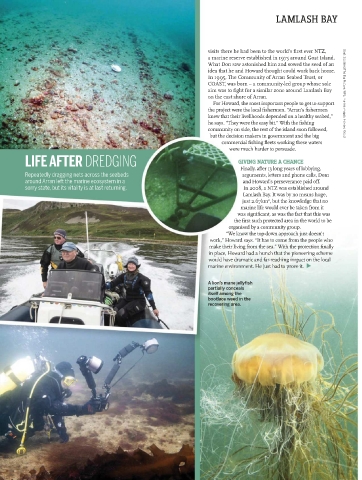
          LIFE AFTER DREDGING                                                     GIVING NATURE A CHANCE
                                                                                  Finally, after 13 long years of lobbying,
          Repeatedly dragging nets across the seabeds                              arguments, letters and phone calls, Dom
          around Arran left the marine ecosystem in a                              and Howard’s perseverance paid off.
          sorry state, but its vitality is at last returning.                      In 2008, a NTZ was established around
                                                                                   Lamlash Bay. It was by no means huge,
                                                                                            2
                                                                                   just 2.67km , but the knowledge that no
                                                                                  marine life would ever be taken from it
                                                                                 was significant, as was the fact that this was
                                                                                the first such protected area in the world to be
                                                                              organised by a community group.
                                                                             “We know the top-down approach just doesn’t
                                                                        w
                                                                        work,” Howard says. “It has to come from the people who
                                                                        make their living from the sea.” With the protection finally
                                                                        m
                                                                        n place, Howard had a hunch that the pioneering scheme
                                                                        in
                                                                        would have dramatic and far-reaching impact on the local
                                                                        w
                                                                       m
                                                                       marine environment. He just had to prove it.
                                                                       A  lion’s mane jellyfish
                                                                       pa
                                                                        artially conceals
                                                                       its self among the
                                                                        ootlace weed in the
                                                                       bo
                                                                       re ecovering area.

