


Page 58 - BBC Wildlife Volume 36 #06
P. 58
LAMLASH BAY


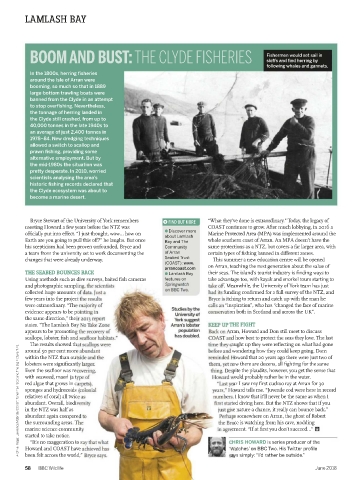
           BOOM AND BUST: THE CLYDEFISHERIES                                               Fishermen would set sail in
                                                                                           skiffs and find herring by
                                                                                           following whales and gannets.
           In the 1800s, herring fisheries
           around the Isle of Arran were
           booming, so much so that in 1889
           large-bottom trawling boats were
           banned from the Clyde in an attempt
           to stop overfishing. Nevertheless,
           the tonnage of herring landed in
           the Clyde still crashed, from up to
           40,000 tonnes in the late 1940s to
           an average of just 2,400 tonnes in
           1978–84. New dredging techniques
           allowed a switch to scallop and
           prawn fishing, providing some
           alternative employment. But by
           the mid-1980s the situation was
           pretty desperate. In 2010, worried
           scientists analysing the area’s
           historic fishing records declared that
           the Clyde ecosystem was about to
           become a marine desert.


           Bryce Stewart of the University of York remembers  + FIND OUT MORE  “What they’ve done is extraordinary.” Today, the legacy of
          meeting Howard a few years before the NTZ was                COAST continues to grow. After much lobbying, in 2016 a
                                                         O Discover more
          officially put into effect. “I just thought, wow… how on      Marine Protected Area (MPA) was implemented around the
                                                         about Lamlash
          Earth are you going to pull this off?” he laughs. But once   Bay and The  whole southern coast of Arran. An MPA doesn’t have the
          his scepticism had been proven unfounded, Bryce and   Community  same protections as a NTZ, but covers a far larger area, with
          a team from the university set to work documenting the   of Arran  certain types of fishing banned in different zones.
                                                         Seabed Trust
          changes that were already underway.                            This summer a new education centre will be opened
                                                         (COAST): www.
                                                         arrancoast.com  on Arran, teaching the next generation about the value of
          THE SEABED BOUNCES BACK                        O Lamlash Bay  their seas. The island’s tourist industry is finding ways to
          Using methods such as dive surveys, baited fish cameras  features on  take advantage too, with kayak and snorkel tours starting to
          and photographic sampl                                            f. Meanwhile, the University of York team has just

          collected huge amounts                                             funding confirmed for a full survey of the NTZ, and
          few years into the projec                                          itching to return and catch up with the man he
          were extraordinary. “Th                                            “inspiration”, who has “changed the face of marine
          evidence appears to be p                                            tion both in Scotland and across the UK”.
          the same direction,” the
          states. “The Lamlash Ba                                              THE FIGHT
          appears to be promotin                                               rran, Howard and Don still meet to discuss
          scallops, lobster, fish an                                            d how best to protect the seas they love. The last
           The results showed th                                               aught up they were reflecting on what had gone
       mage: Lawrence McBr de/COAST; fisherman: Scot and:The B g P cture/NPL  Even the seafloor was re     ted diving here. But the NTZ shows that if you
                                                                               wondering how they could keep going. Dom
          around 50 per cent mor
                                                                                oward that 20 years ago there were just two of
          within the NTZ than ou
                                                                                ow there are dozens, all fighting for the same
          lobsters were significant
                                                                                pite the plaudits, however, you get the sense that
                                                                                ould probably rather be in the water.
          with seaweed, maerl (a t
                                                                                ar I saw my first cuckoo ray at Arran for 30
          red algae that grows in c
                                                                                ward tells me. “Juvenile cod were here in record
          sponges and hydrozoids
          relatives of coral) all twic
                                                                                I know that it’ll never be the same as when I
          abundant. Overall, biodi
          in the NTZ was half as
                                                                                e nature a chance, it really can bounce back.”
          abundant again compare
                                                                                s somewhere on Arran, the ghost of Robert
                                                                                ce is watching from his cave, nodding
          the surrounding areas. T
          started to take notice.
           “It’s no exaggeration to s
                                                                               HRIS HOWARD is series producer of the
          Howard and COAST have
       Arch ve  marine science communit                                        a ement. “If at first you don’t succeed…”
                                                                                 tches’ on BBC Two. His Twitter profile
          been felt across the world,”
                                                                                ys simply: “I’d rather be outside.”
          58  BBC Wildlife                                                                                  June 2018

