


Page 94 - BBC Wildlife Volume 36 #06
P. 94
Q                                                    A
                                Q&
            THE PANEL


               MIKE TOMS
               Ornitholog gist


             SARAH MCPHERSON
                Q&A editor

                                                                  WWW.DISCOVERWILDLIFE.COM


             STUART BLACKMAN        Q   BIRDS
               Science writer
                                    How do kingfishers


                                    excavate their
              AMY-JANE BEER
             Naturalist and author

                                    nesting burrows?


              POLLY PULLAR
                                    A
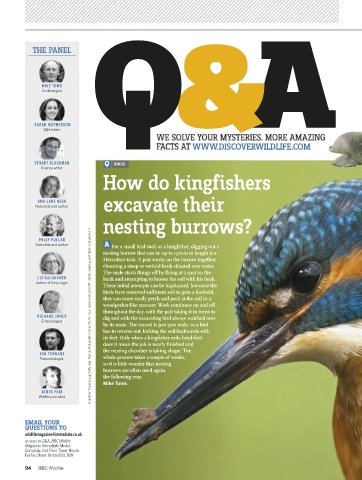
             Naturalist and author     For a small bird such as a kingfisher, digging out a
                                    nesting burrow that can be up to 130cm in length is a
                                    Herculean task. A pair works on the burrow together,
                                    choosing a steep or vertical bank situated over water.
                                    The male starts things off by flying at a spot on the
              LIZ KALAUGHER         bank and attempting to loosen the soil with his beak.
             Author of Furry Logic
                      g
                    y
                                    These initial attempts can be haphazard, but once the
                                    birds have removed sufficient soil to gain a foothold,
                                    they can more easily perch and peck at the soil in a
                                    woodpecker-like manner. Work continues on and off
                                    throughout the day, with the pair taking it in turns to
              RICHARD JONES     Kingfisher: Steve Y oung/Getty; seal: Patricio Rob es Gil/Minden/FLPA; mushroom: Nathan Gr ith/Getty; snail: Laurent Geslin/naturepl.com  dig and with the excavating bird always watched over
               Entomologist
                                    by its mate. The tunnel is just 5cm wide, so a bird
                                    has to reverse out, kicking the soil backwards with
                                    its feet. Only when a kingfisher exits head-first
                                    does it mean the job is nearly finished and
                                    the nesting chamber is taking shape. The
              JON TENNANT
                     g
               Palaeontologist      whole process takes a couple of weeks,
                                    so it is little wonder that nesting
                                    burrows are often used again
                                    the following year.
                                    Mike Toms
               JAMES FAIR
              Wildlife jjournalist


          EMAIL YOUR
          QUESTIONS TO
          wildlifemagazine@immediate.co.uk
          or post to Q&A, BBC Wildlife
          Magazine, Immediate Media
          Company, 2nd Floor,Tower House,
          Fairfax Street, Bristol BS1 3BN
          94  BBC Wildlife

