


Page 96 - BBC Wildlife Volume 36 #06
P. 96
Q&A


                 WHAT

                   IS IT?


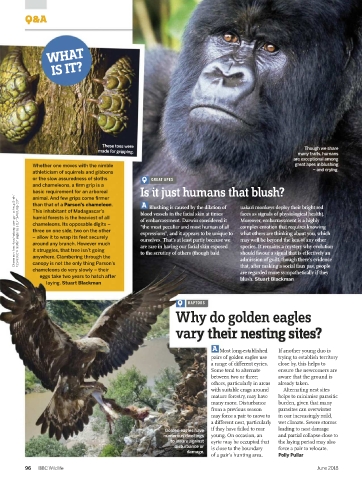
                                    These toes were                                                     Though we share
                                  made for gripping.
                                                                                                      many traits, humans
                                                                                                    are exceptional among
            Whether one moves with the nimble                                                        great apes in blushing
                                                                                                           – and crying.
            athleticism of squirrels and gibbons
            or the slow assuredness of sloths    Q  GREAT APES
            and chameleons, a firm grip is a
            basic requirement for an arboreal    Is it just humans that blush?
      a:AnupShah/  animal. And few grips come firmer  blood vessels in the facial skin at times   uakari monkeys deploy their bright red
                                                 A
            than that of a Parson’s chameleon.
                                                    Blushing is caused by the dilation of
            This inhabitant of Madagascar’s
                                                                                  faces as signals of physiological health).
      Chame eon:A ex Hyde/naturep .com; gor naturepl.com; Golden eagle: Luis Quinta/naturep .com  chameleons. Its opposable digits –  “the most peculiar and most human of all   complex emotion that requires knowing
            humid forests is the heaviest of all
                                                 of embarrassment. Darwin considered it
                                                                                  Moreover, embarrassment is a highly
            three on one side, two on the other
                                                 expressions”, and it appears to be unique to
                                                                                  what others are thinking about you, which
            – allow it to wrap its feet securely
                                                 ourselves. That’s at least partly because we
                                                                                  may well be beyond the ken of any other
            around any branch. However much
                                                 are rare in having our facial skin exposed
                                                                                  species. It remains a mystery why evolution
            it struggles, that tree isn’t going
                                                                                  should favour a signal that is effectively an
                                                 to the scrutiny of others (though bald
            anywhere. Clambering through the
            canopy is not the only thing Parson’s
                                                                                  that, after making a social faux pas, people
            chameleons do very slowly – their                                     admission of guilt, though there’s evidence
                                                                                  are regarded more sympathetically if they
              eggs take two years to hatch after
                                                                                  blush. Stuart Blackman
                 laying. Stuart Blackman
                                                             Q   RAPTORS
                                                            Why do golden eagles
                                                            vary their nesting sites?
                                                                         A  Most long-established  If another young duo is
                                                                        pairs of golden eagles use  trying to establish territory
                                                                        a range of different eyries.  close by, this helps to
                                                                        Some tend to alternate  ensure the newcomers are
                                                                        between two or three;  aware that the ground is
                                                                        others, particularly in areas  already taken.
                                                                        with suitable crags around  Alternating nest sites
                                                                        mature forestry, may have  helps to minimise parasitic
                                                                        many more. Disturbance  burden, given that many
                                                                        from a previous season  parasites can overwinter
                                                                        may force a pair to move to  in our increasingly mild,
                                                                        a different nest, particularly  wet climate. Severe storms
                                                                        if they have failed to rear  leading to nest damage
                                                         Golden eagles have
                                                        numerous dwellings    young. On occasion, an  and partial collapse close to
                                                           to insure against   eyrie may be occupied that  the laying period may also
                                                            disturbance or   is close to the boundary  force a pair to relocate.
                                                                damage.
                                                                        of a pair’s hunting area.  Polly Pullar
          96  BBC Wildlife                                                                                  June 2018

