


Page 99 - BBC Wildlife Volume 36 #06
P. 99
Q&A


          Q  BIRDS
                                                                               Q  INSECTS
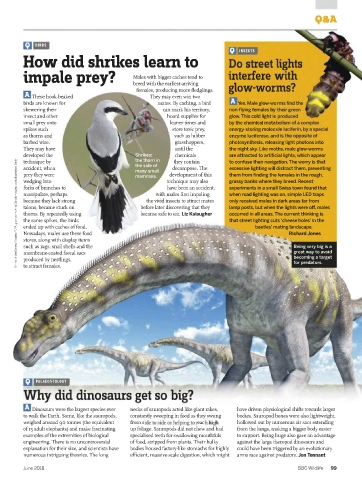
         How did shrikes learn to

         impale prey?                         Males with bigger caches tend to  interfere
                                              breed with the earliest-arriving
                                               females, producing more fledglings.  glow-wor
         A  These hook-beaked                       They may even win two
         birds are known for                          mates. By caching, a bird  A  Yes. Male glow-wo
         skewering their                                can mark his territory,  non-flying females by
         insect and other                                 hoard supplies for   glow. This cold light is
         small prey onto                                   leaner times and    by the chemical meta
         spikes such                                       store toxic prey,   energy-storing molec
         as thorns and                                      such as lubber     enzyme luciferase, an
         barbed wire.                                       grasshoppers,      photosynthesis, releasing light photons into
         They may have                                      until the          the night sky. Like moths, male glow-worms
         developed the                         Shrikes:     chemicals          are attracted to artificial lights, which appear
       Shrike: Michel Geven/Minden/FLPA;glow worm:Andy Sands/naturepl.com; illustration:Getty
         technique by                          the thorn in   they contain     to confuse their navigation. The worry is that
                                               the side of
         accident, when                                    decompose. The      excessive lighting will distract them, preventing
                                               many small
         prey they were                        mammals.   development of this  them from finding the females in the rough,
         wedging into                                    technique may also    grassy banks where they breed. Recent
         forks of branches to                            have been an accident,  experiments in a small Swiss town found that
         manipulate, perhaps                          with males first impaling  when road lighting was on, simple LED traps
         because they lack strong                  the vivid insects to attract mates  only received males in dark areas far from
         talons, became stuck on                 before later discovering that they  lamp posts, but when the lights were of, males
         thorns. By repeatedly using             became safe to eat. Liz Kalaugher  occurred in all areas. The current thinking is
         the same spikes, the birds                                            that street lighting cuts ‘cheese holes’ in the
         ended up with caches of food.                                                 beetles’ mating landscape.
         Nowadays, males use these food                                                            Richard Jones
         stores, along with display items
         such as rags, snail shells and the                                                         Being very big is a
         membrane-coated faecal sacs                                                                great way to avoid
         produced by nestlings,                                                                     becoming a target
                                                                                                    for predators.
         to attract females.


          Q  PALAEONTOLOGY


         A  D                                necks of sauropods acted like giant rakes,  have driven physiological shifts towards larger
            Dinosaurs were the largest species ever
             l
         t to walk the Earth. Some, like the sauropods,  constantly sweeping in food as they swung  bodies. Sauropod bones were also lightweight,
                                                                                                                i
                                                                                                               d
         weighed around 90 tonnes (the equivalent  from s           eac hi h     hollowed out by numerous air sacs extending
                                                                                 h
                                                                                       d
                                                                                           b
                                                                                   l
                                                                                    l
                                             f
              d
                    d
                                                                                                      i
           i
            h
                                   i
                                     l
                             (
                              h
         of 15 adult elephants) and make fascinating  up foliage. Sauropods did not chew and had  from the lungs, making a bigger body easier
         examples of the extremities of biological  specialised teeth for swallowing mouthfuls  to support. Being huge also gave an advantage
         engineering. There is no uncontroversial  of food, stripped from plants. Their bulky  against the large theropod dinosaurs and
         explanation for their size, and scientists have  bodies housed factory-like stomachs for highly  could have been triggered by an evolutionary
         numerous intriguing theories. The long  efficient, massive-scale digestion, which might  arms race against predators. Jon Tennant
         June 2018                                                                                    BBC Wildlife  99

