


Page 97 - BBC Wildlife Volume 36 #06
P. 97
Q&A


         Q  WHAT  CAN  I  SEE N...?                                              NATIONAL PARKS OF THE WORLD
                         I
         EVERGLADES

         FLORIDA, USA


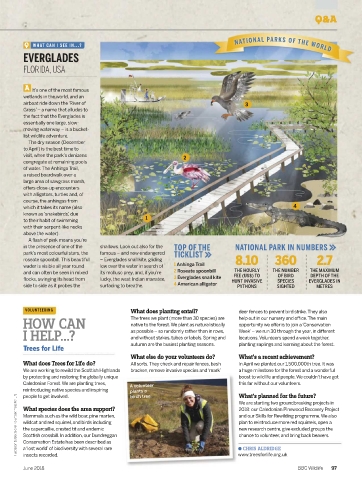
         A  It’s one of the most famous
         wetlands in the world, and an
         airboat ride down the‘River of                                             3
         Grass’– a name that alludes to
         the fact that the Everglades is
         essentially one large, slow-
         moving waterway – is a bucket-
         list wildlife adventure.
           The dry season (December
         to April) is the best time to
         visit, when the park’s denizens
                                                               2
         congregate at remaining pools
         of water.The Anhinga Trail,
         a raised boardwalk over a
         large area of sawgrass marsh,
         offers close-up encounters
         with alligators, turtles and, of
         course, the anhingas from
         which it takes its name (also                                                              4
         known as‘snakebirds’, due
                                                  1
         to their habit of swimming
         with their serpent-like necks
         above the water).
           A flash of pink means you're
         in the presence of one of the  shallows. Look out also for the  TOP OF THE   NATIONAL PARK IN NUMBERS
         park’s most colourful stars, the  famous – and now endangered  TICKLIST
         roseate spoonbill.This beautiful  – Everglades snail kite, gliding      8.10         360           2.7
         wader is visible all year round  low over the water in search of  1 Anhinga Trail
                                                                                THE HOURLY
         and can often be seen in mixed  its mollusc prey, and, if you’re  2 Roseate spoonbill  FEE (US$) TO  THE NUMBER  THE MAXIMUM
                                                                                                          DEPTH OF THE
                                                                                               OF BIRD
         flocks, swinging its head from  lucky, the west Indian manatee,   3 Everglades snail kite  HUNT INVASIVE  SPECIES  EVERGLADES IN
         side to side as it probes the   surfacing to breathe.  4 American alligator  PYTHONS  SIGHTED      METRES

          VOLUNTEERING                       What does planting entail?           deer fences to prevent bird strike.They also
         HOW CAN                             The trees we plant (more than 30 species) are  help out in our nursery and office.The main
                                                                                  opportunity we offer is to join a‘Conservation
                                             native to the forest.We plant as naturalistically
         I HELP...?                          as possible – so randomly rather than in rows,  Week’– we run 30 through the year,in different
                                             and without stakes,tubes or labels.Spring and
                                                                                  locations.Volunteers spend a week together,
                                             autumn are the busiest planting seasons.  planting saplings and learning about the forest.
         Trees for Life
                                             What else do your volunteers do?     What’s a recent achievement?
         What does Trees for Life do?        All sorts.They check and repair fences,bash  InApril we planted our 1,500,000th tree.It was
         We are working to rewild the Scottish Highlands  bracken, remove invasive species and‘mark’   a huge milestone for the forest and a wonderful
         by protecting and restoring the globally unique                          boost to wildlife and people.We couldn’t have got
         Caledonian Forest.We are planting trees,                                 this far without our volunteers.
                                             A volunteer
         reintroducing native species and inspiring  plants a                     What’s planned for the future?
       Illustration by Bex Glover; volunteer: T rees For L fe  What species does the area support?  2018: our Caledonian Pinewood Recovery Project
         people to get involved.
                                             birch tree.
                                                                                  We are starting two groundbreaking projects in
                                                                                  and our Skills for Rewilding programme. We also
         Mammals such as the wild boar, pine marten,
                                                                                  plan to reintroduce more red squirrels,open a
         wildcat and red squirrel,and birds including
         the capercaillie,crested tit and endemic
                                                                                  new research centre,give excluded groups the
                                                                                  chance to volunteer,and bring back beavers.
         Scottish crossbill.In addition,our Dundreggan
         Conservation Estate has been described as
         a‘lost world’of biodiversity with several rare
                                                                                  www.treesforlife.org.uk
         insects recorded.
         June 2018                                                                O CHRIS ALDRIDGE    BBC Wildlife  97

