


Page 279 - The Rough Guide Phrasebook - Egyptian Arabic
P. 279
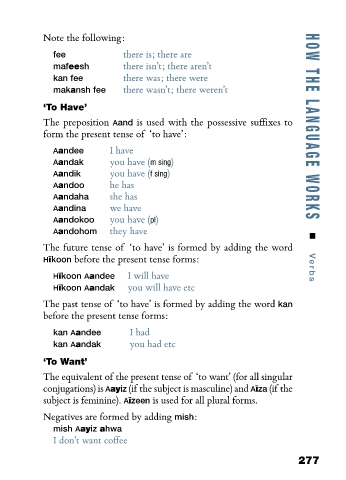
Note the following:
                 fee         there is; there are            HOW
                 mafeesh     there isn’t; there aren’t
                 kan fee     there was; there were          THE
                 makansh fee   there wasn’t; there weren’t
               ‘To Have’                                    LAN
               form the present tense of  ‘to have’:
                           I have
                 aandee
                  The preposition  aand is used with the possessive suffixes to  GUAGE
                  aandak   you have (m	sing)
                  aandik   you have (f	sing)
                  aandoo   he has
                  aandaha   she has                         WORKS
                  aandina   we have
                  aandokoo   you have (pl)
                  aandohom  they have
               The future tense of  ‘to have’ is formed by adding the word
               hīkoon before the present tense forms:        ■      Ve r b s
                  hīkoon aandee   I will have
                  hīkoon aandak   you will have etc
               The past tense of ‘to have’ is formed by adding the word kan
               before the present tense forms:
                 kan aandee   I had
                 kan aandak   you had etc
               ‘To Want’
               The equivalent of the present tense of ‘to want’ (for all singular
               conjugations) is aayiz (if the subject is masculine) and aīza (if the
               subject is feminine). aīzeen is used for all plural forms.
               Negatives are formed by adding mish:
                 mish aayiz ahwa
                 I don’t want coffee

                                                           277


 RG New EGYPTIAN ARABIC How the L277   277                   12/04/2006   16:46:16

