


Page 14 - World of Animals - Issue #29
P. 14
Attack of the hippo


            What makes the hippo so dangerous?


            Responsible for more human deaths than any other, this mammal is one of the planet’s deadliest
            A hippo’s life is relatively peaceful. By day they wallow
            lazily in rivers and lakes, and then venture onto land
            to graze at night. They have few natural predators
            and rarely struggle to find food, with each hippo

            consuming 40 kilograms (88 pounds) of grass per
            evening. From afar, few would guess that a hippo
            presents any risk. Yet these water-dwellers kill
            almost 3,000 humans each year, making them
            one of the world’s most dangerous mammals.
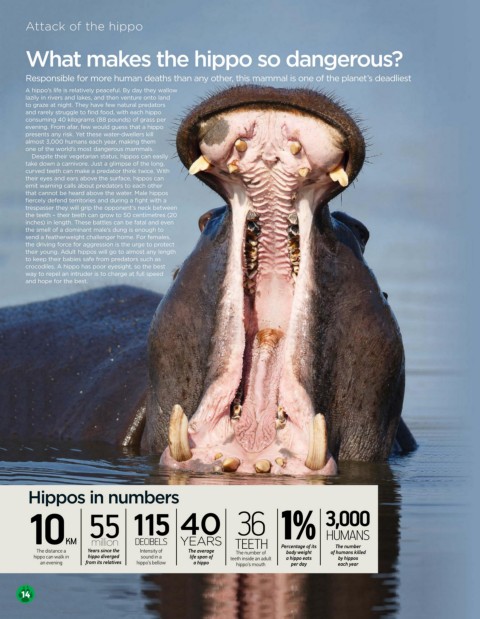
              Despite their vegetarian status, hippos can easily
            take down a carnivore. Just a glimpse of the long,
            curved teeth can make a predator think twice. With
            their eyes and ears above the surface, hippos can
            emit warning calls about predators to each other
            that cannot be heard above the water. Male hippos


            fiercely defend territories and during a fight with a
            trespasser they will grip the opponent’s neck between
            the teeth – their teeth can grow to 50 centimetres (20
            inches) in length. These battles can be fatal and even
            the smell of a dominant male’s dung is enough to
            send a featherweight challenger home. For females,
            the driving force for aggression is the urge to protect
            their young. Adult hippos will go to almost any length
            to keep their babies safe from predators such as
            crocodiles. A hippo has poor eyesight, so the best
            way to repel an intruder is to charge at full speed
            and hope for the best.


             Hippos in numbers

                             55          115          40 36                                   3,000


            10KM              million     DECIBELS    YEARS          TEETH        1% HUMANS
                                                                                                The number
               The distance a   Years since the   Intensity of   The average   The number of   Percentage of its   of humans killed
                                                                                   body weight
              hippo can walk in   hippo diverged   sound in a   life span of   teeth inside an adult   a hippo eats   by hippos
                an evening  from its relatives  hippo’s bellow  a hippo  hippo’s mouth  per day   each year

           14

