


Page 19 - World of Animals - Issue #29
P. 19
Crabs
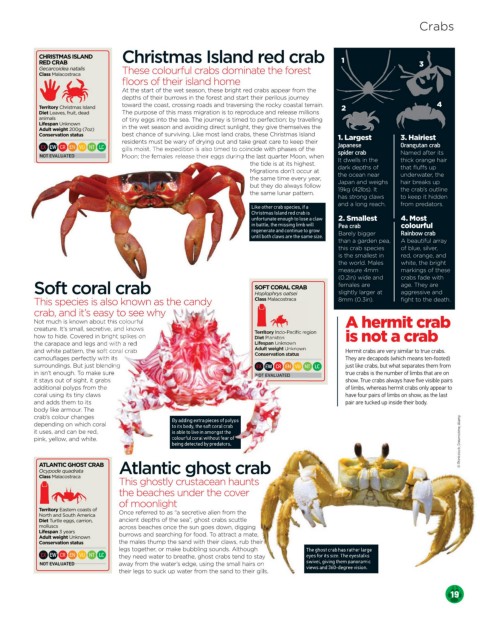
CHRISTMAS ISLAND Christmas Island red crab 1
RED CRAB 3
Gecarcoidea natalis These colourful crabs dominate the forest
Class Malacostraca
floors of their island home
At the start of the wet season, these bright red crabs appear from the
depths of their burrows in the forest and start their perilous journey
Territory Christmas Island toward the coast, crossing roads and traversing the rocky coastal terrain. 2 4
Diet Leaves, fruit, dead The purpose of this mass migration is to reproduce and release millions
animals of tiny eggs into the sea. The journey is timed to perfection; by travelling
Lifespan Unknown in the wet season and avoiding direct sunlight, they give themselves the
Adult weight 200g (7oz)
Conservation status best chance of surviving. Like most land crabs, these Christmas Island 1. Largest 3. Hairiest
residents must be wary of drying out and take great care to keep their Japanese Orangutan crab
gills moist. The expedition is also timed to coincide with phases of the
g i l l s m o i s t . T h e e x p e d i t i o n i s a l s o t i m e d t o c o i n c i d e w i t h p h a s e s o f t h e spider crab
u
r
i
g
g
s d
n
s
a
e l
g t
h
t q
r e
e
e f
m
l
a
h
o
M
o
; t
n
e
e t
s
h
i
e
a
r
s
e
e
l
u
o
o
r M
t
e
e
n
h
n
, w
a
r
NOT EVALUATED
NOT EV ALUA TED Moon; the females release their eggs during the last quarter Moon, when It dwells in the Named after its
thick orange hair
the tide is at its highest. dark depths of that fluffs up
Migrations don’t occur at the ocean near underwater, the
the same time every year, Japan and weighs hair breaks up
but they do always follow 19kg (42lbs). It the crab’s outline
the same lunar pattern.
has strong claws to keep it hidden
and a long reach. from predators.
Like other crab species, if a
Christmas Island red crab is
unfortunate enough to lose a claw 2. Smallest 4. Most
in battle, the missing limb will Pea crab colourful
regenerate and continue to grow Barely bigger Rainbow crab
until both claws are the same size.
than a garden pea, A beautiful array
this crab species of blue, silver,
is the smallest in red, orange, and
the world. Males white, the bright
measure 4mm markings of these
(0.2in) wide and crabs fade with
ra
c
ra
b
l
o
Soft coral crab SOFT CORAL CRAB females are age. They are
S
of
t
c
slightly larger at
aggressive and
Hoplophrys oatsei
T h i s s p e c i e s i s a l s o k n o w n a s t h e c a nd y Class Malacostraca 8mm (0.3in). fight to the death.
This species is also known as the candy
crab, and it’s easy to see why
crab, and it’s easy to see why
i
n
h
r
o
u
f
b
t t
s c
N
w
o
l
o
u
n a
Not much is known about this colourful l A hermit crab
o
u
c
h i
s k
t m
o
u
t
u
a
n
d k
l
r
w
, s
s
r
v
e
t
i
, a
e
c
e
e
creature. It’s small, secretive, and knows Territory Indo-Pacific region
’
. I
a
n
t
c
l
m
r
e
s s
o
errit
errit
ory
Indo-P
ory
c regionc region
acifi
T T
Territory Indo-Pacifi
h o w t o h i d e . C o v e r e d i n b r i g h t s p i k e s o n Diet Plankton is not a crab
how to hide. Covered in bright spikes on
Diet Plankton
n
d
d w
e
i
h a r
t
p
a
s a
n
d l
e
e c
t the carapace and legs and with a red Lifespan Unknown
g
a
r
c
e a
a
h
Lifespan Unknown
Adult weight Unknown
a n d w h i t e p a t t e r n , t h e s o f t c o r a l c r a b Adult weight Unknown Hermit crabs are very similar to true crabs.
and white pattern, the soft coral crab
Conservation status
Conservation status
fl
u
s p
c
camouflages perfectly with its They are decapods (which means ten-footed)
r
a
g
e
a
e
f
e
o
t
h i
t
m
l
i
s
c
t
y w
u
o
u
s
r
B
.
g
t
b
n
n
n
n
e
g
l
s surroundings. But just blending just like crabs, but what separates them from
u
t
di
di
jus
r
u
s
n
’
t e
n i
o
n
e s
k
i in isn’t enough. To make sure NOT EVALUATED true crabs is the number of limbs that are on
h
e
r
a
. T
u
g
o m
ALUA
EV
NOT
TED
i
, i
y
i
h
s
u
t
f s
t s
t g
t o
a
it stays out of sight, it grabs show. True crabs always have five visible pairs
a
g
b
r
s o
t
r
n
additional polyps from the of limbs, whereas hermit crabs only appear to
d
o
o
i
d
e
y
l p
o
h
l
p
a
s f
m t
t
i
a
coral using its tiny claws have four pairs of limbs on show, as the last
and adds them to its pair are tucked up inside their body.
body like armour. The
crab’s colour changes By adding extra pieces of polyps
l
p
s
y
o
x
e
g
a
r
t
n
a
y
B
i
d
d
s
e
o
p
f
c
e
i
p
d e p e n d i n g o n w h i c h c o r a l to its body, the so
coral crab
depending on which coral
coral crab
to its body, the so
it uses, and can be red, is able to live in amongst the
is able to live in amongst the
pink, yellow, and white. colourful coral without fear of
colourful coral without fear of
being detected by predators.
being detected by predators. © Thinkstock; Dreamstime; Alamy © Thinkstock; Dreamstime; Alamy
c g
c g
i
i
o
o
h
h
t
t
l
A A
t
an
t
l
an
t c
t c
s
r
ab
r
ab
s
ATLANTIC GHOST CRAB Atlantic ghost crab
Ocypode quadrata
Class Malacostraca
This ghostly crustacean haunts
the beaches under the cover
of moonlight
Territory Eastern coasts of Once referred to as “a secretive alien from the
North and South America
Diet Turtle eggs, carrion, ancient depths of the sea”, ghost crabs scuttle
molluscs across beaches once the sun goes down, digging
Lifespan 3 years burrows and searching for food. To attract a mate,
Adult weight Unknown
the males thump the sand with their claws, rub their
Conservation status the males thump the sand with their claws, rub their
legs together, or make bubbling sounds. Although The ghost crab has rather large
t
e
a
s r
a
r l
a
r
g
h
e
s
o
r
t c
h
T
h
e g
b h
a
they need water to breathe, ghost crabs tend to stay eyes for its size. The eyestalks
eyes for its size. The eyestalks
they need water to breathe, ghost crabs tend to stay
swivel, giving them panoramic
away from the water’s edge, using the small hairs on
NOT EVALUATED away from the water’s edge, using the small hairs on swivel, giving them panoramic
views and 360-degree vision.
their legs to suck up water from the sand to their gills.
their legs to suck up water from the sand to their gills. views and 360-degree vision.
19

