


Page 18 - World of Animals - Issue #29
P. 18
Meet the family
Crabs
c
e
p
s o
e
i
0 s
h 6
t
i
0
7
,
f t
n
i
v
n
g i
i
e c
u
r
b l
a
r
W
With 6,700 species of true crab living in
fresh water, the oceans and on land, leg
fresh water, the oceans and on land, leg
spans range from tiny to huge. Here
spans range from tiny to huge. Here
are the most diverse crustaceans ARROW CRAB
ARRO
W CRAB
S
Stenorhynchus seticornis
ynchus setic
t
enorh
ornis
tr
aca
os
Clas
Class Malacostraca
s
Malac
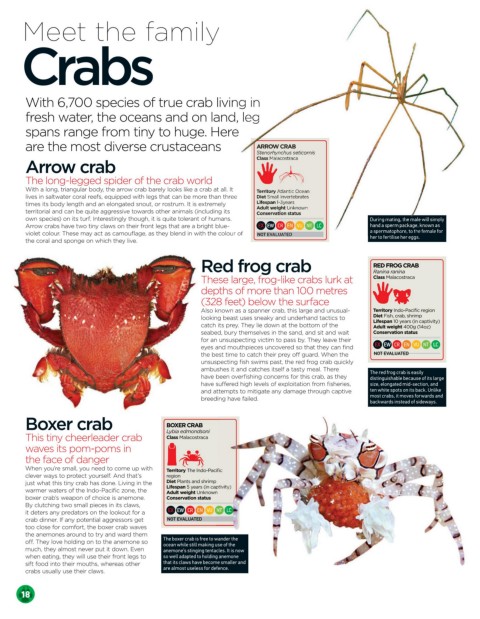
Arrow crab
The long-legged spider of the crab world
b b
a
r
a
l
y l
r
e
h
e a
y
, t
o
w c
r
r
W
r
l
t
. I
t a
l
a
b a
With a long, triangular body, the arrow crab barely looks like a crab at all. It Territory Atlantic Ocean
k
o
o
k
e a c
s l
i
r b
n
h a l
i
t
i
r
l
a
n
g
o
, t
g
o
d
a
u
errit
ory
A
ory
ean
Territory Atlantic Ocean
T T
tlantic Oc
errit
w
r
t
n b
e
o
a
e m
e
s i
n s
r
v
i
e
e
l
h
e t
t
a
h
a
n t
r
s t
g
h l
e
o
f
s
, e
h
e
t
p
l r
e
i
p
u
q
a
i
e
d w
a
l lives in saltwater coral reefs, equipped with legs that can be more than three Diet Small invertebrates
t c
a
r c
Diet Small invertebrates
Lifespan 1-3years
times its body length and an elongated snout, or rostrum. It is extremely Lifespan 1-3years
Adult weight Unknown
territorial and can be quite aggressive towards other animals (including its Adult weight Unknown
Conservation status
Conservation status
own species) on its turf. Interestingly though, it is quite tolerant of humans. D During mating, the male will simply
l s
i
i
y
l
u
r
l
m
i
n
g
, t
p
a
t
i
l
n
e w
a
h
e m
g m
Arrow crabs have two tiny claws on their front legs that are a bright blue- hand a sperm package, known as
hand a sperm package, known as
a spermatophore, to the female for
v i o l e t c o l o u r . T h e s e m a y a c t a s c a m o u fl a g e , a s t h e y b l e n d i n w i t h t h e c o l o u r o f NOT EVALUATED a spermatophore, to the female for
violet colour. These may act as camouflage, as they blend in with the colour of
EV
NOT
ALUA
TED
her to fertilise her eggs.
the coral and sponge on which they live. her to fertilise her eggs.
Red frog crab RED FROG CRAB
These large, frog-like crabs lurk at Ranina ranina
Class Malacostraca
depths of more than 100 metres
(328 feet) below the surface
Also known as a spanner crab, this large and unusual- Territory Indo-Pacific region
looking beast uses sneaky and underhand tactics to Diet Fish, crab, shrimp
Lifespan 10 years (in captivity)
catch its prey. They lie down at the bottom of the Adult weight 400g (14oz)
seabed, bury themselves in the sand, and sit and wait Conservation status
for an unsuspecting victim to pass by. They leave their
eyes and mouthpieces uncovered so that they can find
the best time to catch their prey off guard. When the NOT EVALUATED
unsuspecting fish swims past, the red frog crab quickly
ambushes it and catches itself a tasty meal. There The red frog crab is easily
have been overfishing concerns for this crab, as they distinguishable because of its large
have suffered high levels of exploitation from fisheries, size, elongated mid-section, and
and attempts to mitigate any damage through captive ten white spots on its back. Unlike
breeding have failed. most crabs, it moves forwards and
backwards instead of sideways.
Boxer crab BOXER CRAB
This tiny cheerleader crab Lybia edmondsoni
Class Malacostraca
waves its pom-poms in
the face of danger
When you’re small, you need to come up with Territory The Indo-Pacific
c
The Indo-Pacifi
clever ways to protect yourself. And that’s region
just what this tiny crab has done. Living in the Diet Plants and shrimp
5 years (in captivity)
warmer waters of the Indo-Pacific zone, the Lifespan 5 years (in captivity)
Unknown
Adult weight Unknown
boxer crab’s weapon of choice is anemone. Conservation status
By clutching two small pieces in its claws,
it deters any predators on the lookout for a
crab dinner. If any potential aggressors get NOT EVALUATED
too close for comfort, the boxer crab waves
the anemones around to try and ward them
off. They love holding on to the anemone so The boxer crab is free to wander the
ocean while still making use of the
much, they almost never put it down. Even anemone’s stinging tentacles. It is now
when eating, they will use their front legs to so well adapted to holding anemone
sift food into their mouths, whereas other that its claws have become smaller and
crabs usually use their claws. are almost useless for defence.
18

