


Page 23 - World of Animals - Issue #29
P. 23
Why save the panda?


                                                                                    into captive breeding situations until we could resolve
                                                                                    what the problem was. They finally worked out it was the
                                                                                    impact of an invasive fungus, called chytrid fungi, resulting
                                                                                    in a disease called chytridiomycosis. It’s a massive disease
                                                                                    epidemic driving lots of frog species towards extinction
                                                                                    very rapidly. We have already lost several iconic species.
                                                                                      Yet it’s not just well-known species at risk; it’s lots of
                                                                                    species, which is why we run other fundraising campaigns.
                                                                                    We linked our bumblebee campaign to food security
                                                                                    because they play a vital role in pollinating crops. People
                                                                                    could buy into that and understand the importance of
                                                                                    conserving bumblebees. It’s going to be a bigger challenge
                                                                                    for us when we want to look at snakes or spiders, or things
                                                                                    people don’t really like much. However, it can be amazing
                                                                                    how quickly people’s perceptions can change – marketing
                                                                                    is key. You’re competing with campaigns for all iconic
                                                                                    species but it’s how you use and link those two things
                                                                                    together. You need to get the balance right.

                                                                                                BugLife
                                                                                                Paul Hetherington
                                                                                                Director of Fundraising and Communications
                                                                                                BugLife are the only organisation in
                                                                                                Europe dedicated to conserving and
                                                                                     protecting all invertebrate species
                                                                                    The iconic species are cute, but they won’t
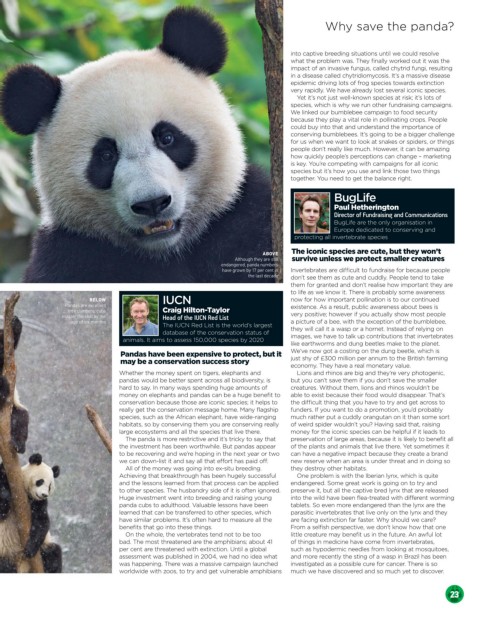
                                                                             ABOVE
                                                                     Although they are still   survive unless we protect smaller creatures
                                                                 endangered, panda numbers
                                                                  have grown by 17 per cent in   Invertebrates are difficult to fundraise for because people
                                                                         the last decade  don’t see them as cute and cuddly. People tend to take
                                                                                    them for granted and don’t realise how important they are
                                                                                    to life as we know it. There is probably some awareness
                             BELOW               IUCN                               now for how important pollination is to our continued
                       Pandas are excellent                                         existence. As a result, public awareness about bees is
                        tree climbers; cubs      Craig Hilton-Taylor
                      master the skill by the    Head of the IUCN Red List          very positive; however if you actually show most people
                        age of six months                                           a picture of a bee, with the exception of the bumblebee,
                                                 The IUCN Red List is the world’s largest   they will call it a wasp or a hornet. Instead of relying on
                                                 database of the conservation status of
                                       animals. It aims to assess 150,000 species by 2020  images, we have to talk up contributions that invertebrates
                                                                                    like earthworms and dung beetles make to the planet.
                                      Pandas have been expensive to protect, but it   We’ve now got a costing on the dung beetle, which is
                                      may be a conservation success story           just shy of £300 million per annum to the British farming
                                                                                    economy. They have a real monetary value.
                                      Whether the money spent on tigers, elephants and   Lions and rhinos are big and they’re very photogenic,
                                      pandas would be better spent across all biodiversity, is   but you can’t save them if you don’t save the smaller
                                      hard to say. In many ways spending huge amounts of   creatures. Without them, lions and rhinos wouldn’t be
                                      money on elephants and pandas can be a huge benefit to   able to exist because their food would disappear. That’s
                                      conservation because those are iconic species; it helps to   the difficult thing that you have to try and get across to
                                      really get the conservation message home. Many flagship   funders. If you want to do a promotion, you’d probably
                                      species, such as the African elephant, have wide-ranging   much rather put a cuddly orangutan on it than some sort
                                      habitats, so by conserving them you are conserving really   of weird spider wouldn’t you? Having said that, raising
                                      large ecosystems and all the species that live there.   money for the iconic species can be helpful if it leads to
                                       The panda is more restrictive and it’s tricky to say that   preservation of large areas, because it is likely to benefit all
                                      the investment has been worthwhile. But pandas appear   of the plants and animals that live there. Yet sometimes it
                                      to be recovering and we’re hoping in the next year or two   can have a negative impact because they create a brand
                                      we can down-list it and say all that effort has paid off.   new reserve when an area is under threat and in doing so
                                       All of the money was going into ex-situ breeding.   they destroy other habitats.
                                      Achieving that breakthrough has been hugely successful   One problem is with the Iberian lynx, which is quite
                                      and the lessons learned from that process can be applied   endangered. Some great work is going on to try and
                                      to other species. The husbandry side of it is often ignored.   preserve it, but all the captive bred lynx that are released
                                      Huge investment went into breeding and raising young   into the wild have been flea-treated with different worming
                                      panda cubs to adulthood. Valuable lessons have been   tablets. So even more endangered than the lynx are the
                                      learned that can be transferred to other species, which   parasitic invertebrates that live only on the lynx and they
                                      have similar problems. It’s often hard to measure all the   are facing extinction far faster. Why should we care?
                                      benefits that go into these things.            From a selfish perspective, we don’t know how that one
                                       On the whole, the vertebrates tend not to be too   little creature may benefit us in the future. An awful lot
                                      bad. The most threatened are the amphibians; about 41   of things in medicine have come from invertebrates,
                                      per cent are threatened with extinction. Until a global   such as hypodermic needles from looking at mosquitoes,
                                      assessment was published in 2004, we had no idea what   and more recently the sting of a wasp in Brazil has been
                                      was happening. There was a massive campaign launched   investigated as a possible cure for cancer. There is so
                                      worldwide with zoos, to try and get vulnerable amphibians   much we have discovered and so much yet to discover.

                                                                                                                               23

