


Page 22 - World of Animals - Issue #29
P. 22
Why save the panda?

            The panda debate


            What do the experts have to say about whether
            the panda should be a conservation priority?


                        WWF                                           RZSS Edinburgh Zoo
                        Nicola Loweth                                 Iain Valentine
                        WWF UK Regional Officer for China and India   Director of Giant Panda Project and
                        The World Wildlife Fund is one of             Strategic Innovations
                        the largest and most recognisable             Edinburgh Zoo is the only organisation in
             organisations dedicated to protecting species   the United Kingdom that houses giant pandas

            The many benefits of panda conservation         Giant pandas are too important a species to
            reach far beyond the bears themselves          be allowed to become extinct
            The inspiration for our logo came from Chi-Chi: a giant   As a result of a partnership with the China Wildlife
            panda that arrived at London Zoo in 1961 – the same   Conservation Association – a large, non-profit organisation
            year that WWF was created. Aware of the need for a   dedicated to giant panda conservation – the Royal
            recognisable symbol that would overcome all language   Zoological Society of Scotland (RZSS) is bringing skills in
            barriers, WWF's founders agreed that the big, furry   animal nutrition, genetics, embryology, immunology and
            bear with her distinctive black and white coat would   veterinary medicine, which are vital areas of research for
            make a great logo. Sir Peter Scott, one of our founders,   giant pandas, to the global effort to save the species. This
            said at the time: "We wanted an animal that is beautiful,   will ensure a genetically healthy and diverse population
            endangered, and loved by many people in the world for   exists ex-situ, as well as in the wild. We are also in the
            its appealing qualities. We also wanted an animal that had  position to aid a fellow conservation body financially, with
            an impact in black and white to save money on printing   this money being targeted towards the restoration of
            costs.” The giant panda has now become an instantly   bamboo habitat in China.
            recognisable symbol, not just for WWF, but also for the   People are normally very excited to see a giant panda
            conservation movement as a whole.              with their own eyes. In many people it brings out a real
              The Upper Yangtze basin where giant pandas are   childlike quality as they gaze at an animal that they’ve
            found is one of the most important global biodiversity   read about since they were children and perhaps even
            hotspots. Although pandas remain threatened, panda   owned a cuddly toy of. For many visitors this will be the
            conservation is about much more than just the giant   first and only time they have seen a giant panda without
            panda itself. The status of the giant panda directly   the medium of television. This iconic species is very easy
            reflects the quality of habitat and the health of the entire   to anthropomorphise – the way they eat sitting up while
            ecosystem, so protecting wild pandas will also serve to   using their hands and their special pseudo thumb, which
            protect many other species of rare plants and wildlife.   is a modified wrist bone. They also have distinctive black
            Recent research found that 70 per cent of China’s   eye patches that make their eyes look even bigger and as
            endemic forest mammals, 70 per cent of forest birds and   humans we are programmed to respond to these features
            31 per cent of forest amphibians all live within the panda’s   in our own young. Giant pandas act as ambassadors,
            range and the nature reserves set aside to protect them.  raising awareness about conservation in general; when
              Protecting pandas is also important for people. The   visitors come to see Tian Tian and Yang Guang they
            forests where pandas live are important for controlling   also learn about the plight of many other animals, the
            soil erosion and reducing the severity of flooding,   importance of preserving ecological diversity and how
            so conserving giant panda habitat helps to protect   they can help.
            water provisions for millions of people residing in and
            downstream of the panda’s range.
              Unfortunately we cannot save every threatened species
            in the world, but we hope to mitigate key threats. We are
            in this for the long term and have focused work on many
            iconic species such as tigers, pandas, and elephants. By
            conserving key ecosystems, we also provide benefits
            to all of these species that are found in those habitats,
            including those less-known or less attractive species.
            Iconic species can draw attention to the plight of others
            and help generate support to protect biodiversity that
            shares the same habitat.

           “Protecting wild pandas will
            also serve to protect many

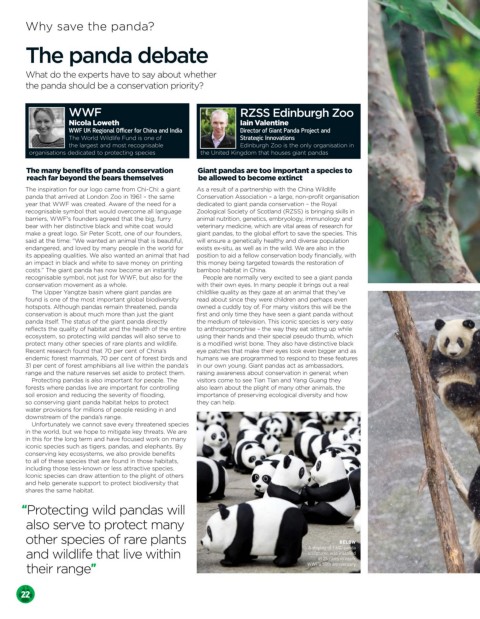
            other species of rare plants                                                         BELOW
                                                                                         A display of 1,600 panda
            and wildlife that live within                                                sculptures was installed
                                                                                            in 25 cities to mark
            their range”                                                                 WWF’s 50th anniversary


           22

