


Page 42 - World of Animals - Issue #29
P. 42
Atlantic puffin

            Life at sea


            Atlantic puffins spend most of their lives out on the waves

            Atlantic puffins are usually spotted on steep, inaccessible clifftops   With their black and white colouring, puffins look a bit like
            during the spring and summer when they come ashore to breed,   penguins, but the similarities don’t end there. Puffins play a similar
            but these vast colonies don’t remain together for long. Puffins are   ecological role in the Northern Hemisphere to that of penguins
            seabirds, and spend most of their time out on the Atlantic Ocean.  in the Southern Hemisphere, both spending their time out at sea
              During the winter, the puffins spread far and wide across   catching fish and returning to land to breed, often mating for life.
            the North Atlantic, landing on shores miles from their breeding   However, a key difference sets the birds apart; unlike penguins,
            grounds. Using a combination of swimming, flying and floating,   which cannot fly, puffins are smaller and more compact, allowing
            they are able to survive far away from the coast.    them to get airborne. Their stocky bodies and short wings make
              Tracking the birds after they disperse is challenging, so we know   them clumsy in the air, but by rapidly beating their wings, Atlantic
            relatively little about their behaviour during this time, but they are   puffins can fly at speeds of 88 kilometres (55 miles) per hour.
            well suited to their ocean environment. The puffins preen their   For a short period each year, Atlantic puffins become flightless.
            feathers often, coating themselves in water-repelling oil, and their   After the breeding season ends, the birds molt in preparation for
            rounded bodies float easily on the surface of the water.   the winter, beginning with their beaks and face, and followed by
              They are adapted for swimming, and are exceptional   their primary and secondary flight feathers. Not much is known
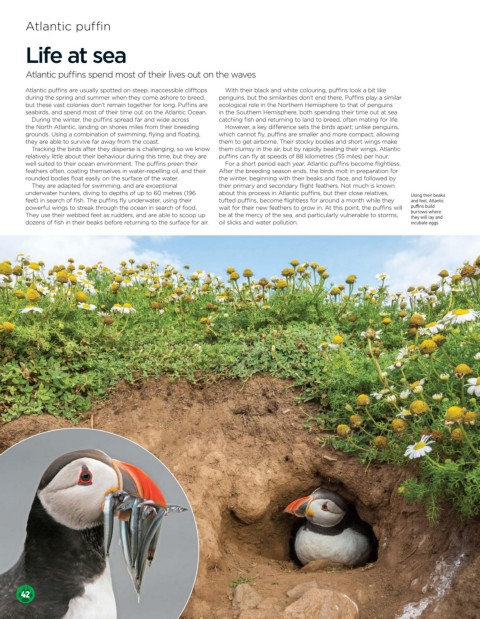
            underwater hunters, diving to depths of up to 60 metres (196   about this process in Atlantic puffins, but their close relatives,   Using their beaks
            feet) in search of fish. The puffins fly underwater, using their   tufted puffins, become flightless for around a month while they   and feet, Atlantic
            powerful wings to streak through the ocean in search of food.   wait for their new feathers to grow in. At this point, the puffins will   puffins build
            They use their webbed feet as rudders, and are able to scoop up   be at the mercy of the sea, and particularly vulnerable to storms,   burrows where
                                                                                                                     they will lay and
            dozens of fish in their beaks before returning to the surface for air.  oil slicks and water pollution.   incubate eggs


                                                                                                               Most of our knowledge of sea
                                                                                                              turtles comes from egg-laying
                                                                                                               females and their hatchlings

           42

