


Page 46 - World of Animals - Issue #29
P. 46
Atlantic puffi n


            Inside the                              Mandible


            Atlantic puffi n                                                                                           Oesophagus


            The distinctive feet and beaks of

            Atlantic puffins have earned them
            nicknames like ‘sea clowns’ and ‘sea                                                                      Trachea
            parrots’, but beneath their colourful
            exterior is some incredible anatomy                                                                           Lung


             ATLANTIC PUFFIN
             Fratercula arctica
             Class Aves


             Territory North Atlantic Ocean
             Diet Fish
             Lifespan 20 years
             Adult weight 500g (18oz)
             Conservation status

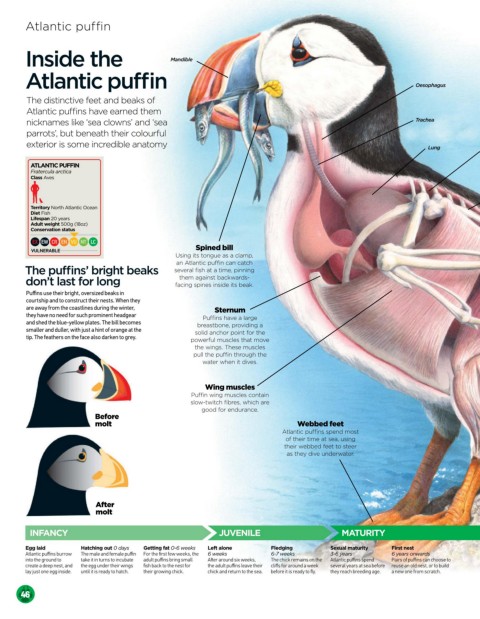
                                                          Spined bill
              VULNERABLE
                                                     Using its tongue as a clamp,

                                                     an Atlantic puffin can catch

            The puffins’ bright beaks                 several fish at a time, pinning

                                                      them against backwards-
            don’t last for long                      facing spines inside its beak.
            Puffi ns use their bright, oversized beaks in

            courtship and to construct their nests. When they
            are away from the coastlines during the winter,    Sternum
            they have no need for such prominent headgear   Puffins have a large

            and shed the blue-yellow plates. The bill becomes   breastbone, providing a
            smaller and duller, with just a hint of orange at the   solid anchor point for the
            tip. The feathers on the face also darken to grey.   powerful muscles that move
                                                          the wings. These muscles

                                                          pull the puffin through the
                                                            water when it dives.
                                                             Wing muscles

                                                         Puffin wing muscles contain

                                                         slow-twitch fibres, which are
                                                            good for endurance.
                               Before
                               molt                                                   Webbed feet
                                                                                  Atlantic puffins spend most

                                                                                   of their time at sea, using
                                                                                  their webbed feet to steer
                                                                                   as they dive underwater.


                               After
                               molt

             INFANCY                                             JUVENILE                         MATURITY

            Egg laid       Hatching out 0 days  Getting fat 0-6 weeks  Left alone   Fledging   Sexual maturity  First nest

            Atlantic puffi ns burrow   The male and female puffi  n   For the first few weeks, the   6 weeks  6-7 weeks  3-6 years  6 years onwards


            into the ground to   take it in turns to incubate   adult puffi ns bring small   A er around six weeks,   The chick remains on the   Atlantic puffi ns spend   Pairs of puffi ns can choose to

            create a deep nest, and   the egg under their wings   fish back to the nest for   the adult puffi ns leave their   cliffs for around a week   several years at sea before  reuse an old nest, or to build


            lay just one egg inside.  until it is ready to hatch.  their growing chick.  chick and return to the sea.  before it is ready to fly.  they reach breeding age.  a new one from scratch.

           46

