


Page 47 - World of Animals - Issue #29
P. 47
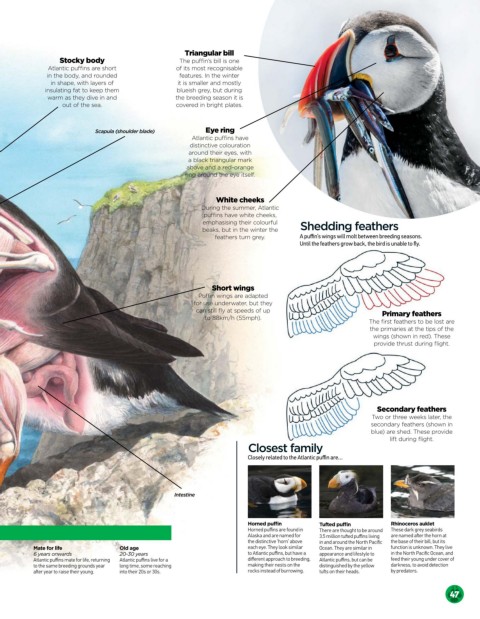
Triangular bill
                     Stocky body                      The puffin’s bill is one

                  Atlantic puffins are short          of its most recognisable

                  in the body, and rounded            features. In the winter
                   in shape, with layers of          it is smaller and mostly
                 insulating fat to keep them         blueish grey, but during
                  warm as they dive in and           the breeding season it is
                      out of the sea.                covered in bright plates.


                               Scapula (shoulder blade)      Eye ring

                                                         Atlantic puffins have
                                                         distinctive colouration
                                                        around their eyes, with
                                                        a black triangular mark
                                                        above and a red-orange
                                                       ring around the eye itself.


                                                                White cheeks
                                                            During the summer, Atlantic

                                                            puffins have white cheeks,
                                                            emphasising their colourful   Shedding feathers
                                                            beaks, but in the winter the

                                                                feathers turn grey.    A puffi n’s wings will molt between breeding seasons.
                                                                                       Until the feathers grow back, the bird is unable to fly.


                                                               Short wings

                                                           Puffin wings are adapted
                                                          for use underwater, but they
                                                          can still fly at speeds of up                       Primary feathers

                                                             to 88km/h (55mph).

                                                                                                         The first feathers to be lost are
                                                                                                          the primaries at the tips of the
                                                                                                           wings (shown in red). These
                                                                                                           provide thrust during flight.


                                                                                                            Secondary feathers
                                                                                                          Two or three weeks later, the
                                                                                                          secondary feathers (shown in
                                                                                                          blue) are shed. These provide
                                                                                                               lift during flight.

                                                                         Closest family

                                                                         Closely related to the Atlantic puffi n are…


                                                     Intestine


                                                                         Horned puffin       Tufted puffin       Rhinoceros auklet


                                                                         Horned puffi ns are found in   There are thought to be around   These dark grey seabirds

                                                                         Alaska and are named for   3.5 million tu ed puffi ns living   are named a er the horn at


                                                                         the distinctive ‘horn’ above   in and around the North Pacific   the base of their bill, but its

              Mate for life           Old age                            each eye. They look similar   Ocean. They are similar in   function is unknown. They live
              6 years onwards         20-30 years                        to Atlantic puffi ns, but have a   appearance and lifestyle to   in the North Pacific Ocean, and


              Atlantic puffi ns mate for life, returning   Atlantic puffi ns live for a   different approach to breeding,   Atlantic puffi ns, but can be   feed their young under cover of

              to the same breeding grounds year   long time, some reaching   making their nests on the   distinguished by the yellow   darkness, to avoid detection
              a er year to raise their young.  into their 20s or 30s.    rocks instead of burrowing.   tu s on their heads.  by predators.


                                                                                                                               47

